7 most common WordPress problems signal isolated errors or deeper technical debt. Agencies need to determine if a site requires a quick fix, stabilization, or redevelopment.
Distinguish isolated issues from recurring failures before choosing the scope of remediation.
Identify plugin conflicts, database bloat, hosting limitations, and undocumented dependencies that create ongoing instability.
Resolve critical errors, database failures, broken links, and media issues by addressing root causes.
Investigate slow performance, broken forms, tracking, and integrations to prevent disruptions to business-critical workflows.
Bring in WordPress engineering support when fragile dependencies and repeated failures make routine maintenance ineffective.
Most common WordPress problems stem from a few core areas: plugins, themes, custom code, databases, hosting, routing, integrations, or maintenance practices. Many can be resolved with targeted fixes, but recurring failures, risky updates, and undocumented dependencies may signal the need for structured stabilization, a complete rebuild, or dedicated WordPress development services.
For agencies, the challenge often starts with an inherited site: a client hands over a website with limited documentation, unknown customizations, and dependencies managed by previous vendors. Before touching production, the team must leverage professional WordPress development services to determine if they can safely diagnose and maintain the existing setup.
Isolated plugin conflicts or broken redirects may require only targeted fixes. Effective WordPress troubleshooting starts by identifying the root cause, assessing the wider dependencies, and choosing the appropriate scope of work: repair, stabilize, or redevelop.
Before you troubleshoot an inherited WordPress site, stabilize the situation
Before fixing an inherited WordPress website, agencies need to establish a safe baseline for troubleshooting. Even a minor plugin update or configuration change can disrupt a business-critical workflow if the site’s dependencies, ownership, and recovery options are unclear.
Website changes taking longer than they should?
Manage CMS, front-end, and site tasks in one workflow
Start with these six checks before making changes to production.
1. Confirm access and ownership
Verify WordPress administrator privileges, hosting control panel access, database credentials, domain and DNS management, and SFTP/SSH access where applicable. Check who controls the code repository, paid plugin licenses, email services, analytics accounts, and third-party integrations. Missing access can turn a straightforward repair into a prolonged incident.
2. Verify backups and recovery options
Confirm that a recent backup includes the necessary files and database, and establish where it is stored. More importantly, determine whether the site can actually be restored. An automated backup without a verified recovery procedure is not a reliable rollback plan.
3. Prepare a staging environment
Use staging to test plugin and theme conflicts, WordPress updates, database cleanup, and custom code changes whenever the hosting setup allows it. This reduces the risk of disrupting the live site, customer transactions, or lead generation. WordPress documentation recommends staging or an appropriate backup before debugging modifications.
4. Review recent changes
Document updates to WordPress core, plugins, themes, PHP versions, and server configurations. Check recent deployments, hosting or DNS migrations, content changes, and newly connected integrations. The timing of a failure often helps narrow down its possible causes.
5. Collect diagnostic evidence
Record the exact error, affected URLs, templates, and users, along with when the issue first appeared. Review WordPress Site Health, PHP and server logs, and available hosting metrics. Establish whether the problem is isolated, intermittent, or affecting multiple workflows before attempting a fix.
6. Make controlled, reversible changes
Change one variable at a time, validate the result, and retain a rollback path. Avoid updating every plugin or modifying production files simultaneously, especially when forms, payments, or integrations are business-critical.
This approach helps agencies and brands distinguish a contained technical issue from broader instability without introducing additional failures. It also creates a documented starting point for maintenance, stabilization, or redevelopment decisions.
Common WordPress problems: What the symptoms really mean
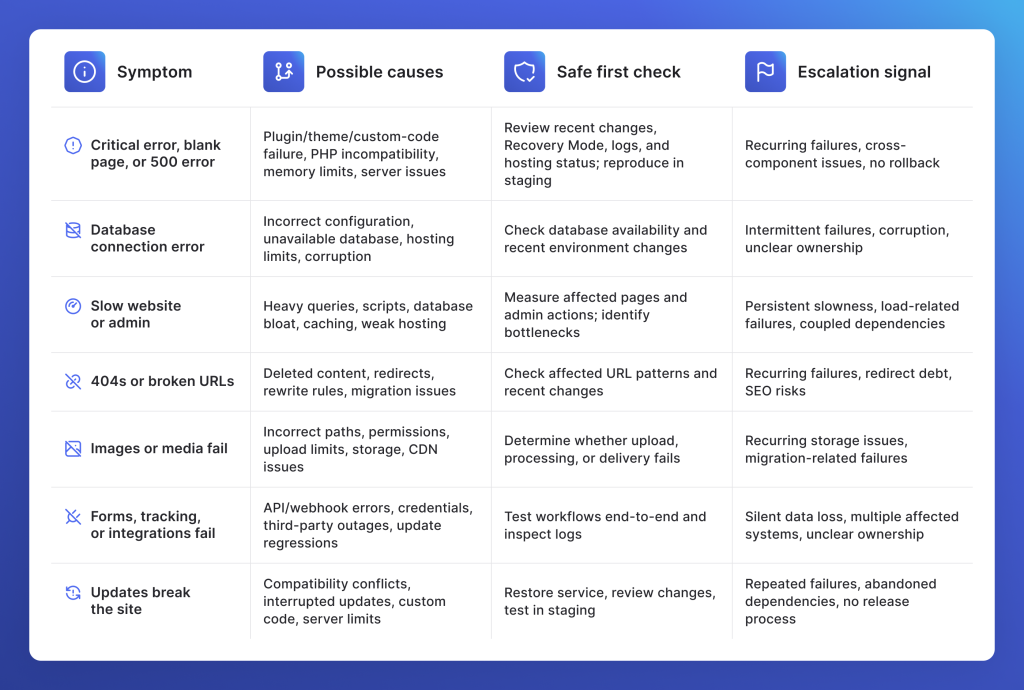
Common WordPress problems often produce similar symptoms even when their underlying causes differ. A blank page might result from a plugin conflict, incompatible PHP code, or a server failure. Likewise, a slow website may point to inefficient database queries, hosting limitations, or third-party scripts rather than a single faulty component.
The first step is to identify possible causes, perform safe initial checks, and recognize when an isolated issue may indicate broader instability. The table below provides a starting point for WordPress troubleshooting before deciding whether a targeted fix or more extensive investigation is needed.
7 common WordPress problems that signal deeper website issues
A broken WordPress site doesn’t always need a major overhaul. But when a seemingly simple fix triggers another failure, the real problem may lie deeper. Here’s how to recognize seven common issues, trace their causes, and spot when a quick fix won’t be enough.
1. Critical errors, blank pages, and 500 errors after an update or change
A WordPress critical error, the White Screen of Death (WSOD), or a 500 Internal Server Error can make a website or its admin dashboard inaccessible. These symptoms may result from PHP fatal errors, plugin or theme conflicts, custom code, incompatible PHP versions, exhausted memory, corrupted files, or server-level failures.
Start WordPress troubleshooting by reviewing recent updates, deployments, and hosting changes. If WordPress sends a Recovery Mode email, it may identify the failing component and provide temporary admin access. PHP and server logs can help narrow down the cause.
For deeper diagnosis, developers can use WP_DEBUG and WP_DEBUG_LOG in a staging environment. Keep WP_DEBUG_DISPLAY disabled to prevent exposing errors to visitors, protect diagnostic logs, and turn off temporary debugging after testing.
An isolated error with a confirmed cause and safe rollback may need only a targeted fix. Repeated failures after updates, multiple affected components, or an unclear PHP error source indicate deeper instability that may require specialist WordPress engineering support.
2. Plugin, theme, or compatibility conflicts
A plugin or theme conflict can break page layouts, disable functionality, or trigger errors after an otherwise routine update. The cause isn’t necessarily a faulty plugin. WordPress plugin conflicts and WordPress theme conflicts often stem from incompatible versions, overlapping functionality, deprecated code, JavaScript or CSS collisions, custom snippets, or third-party integrations.
Start by checking recent WordPress core, plugin, theme, and PHP version changes. WordPress Site Health can reveal configuration and compatibility concerns, while browser console errors and PHP logs may help identify affected components.
When possible, reproduce the issue in staging and isolate the conflicting plugin, theme, or customization without disrupting the live site. Record the exact component versions and conditions that trigger the failure so the team can test a compatible update or targeted code fix.
A single compatibility conflict may be straightforward to resolve. When multiple plugins, custom code, and integrations depend on one another, even a minor update can require coordinated changes and broader compatibility testing.
3. Database connection errors and database bloat
A WordPress database connection error can take an entire website offline, while database bloat gradually slows page loading, admin operations, and routine maintenance. Both problems can originate in the database layer, but they require different diagnostic approaches.
Connection failures may result from incorrect credentials in wp-config.php, an unavailable database service, hosting resource limits, corrupted tables, or recent environment changes. Start by checking hosting and database availability, reviewing recent migrations or configuration updates, and examining server logs before modifying credentials or database settings.
WordPress database bloat can develop as revisions, expired transients, excessive postmeta, and oversized autoloaded data accumulate. Frequent plugin installations and removals can also leave orphaned tables and unused data behind, increasing query overhead and complicating maintenance.
Before cleanup, verify a current backup and inspect database size, slow queries, autoloaded data, and plugin-related tables to identify the actual bottlenecks. Removing data without understanding its dependencies can disrupt site functionality.
An isolated connection error may require only a configuration or hosting fix. Recurring connection failures, unexplained data growth, or dependencies on abandoned plugin tables call for a broader database audit and a controlled cleanup plan.
4. Slow front-end or a slow WordPress admin dashboard
A slow WordPress site can frustrate visitors, hurt conversions, and make routine content updates unnecessarily time-consuming. Performance issues may affect the frontend, WordPress admin, or both, depending on where the bottleneck occurs.
Common causes include expensive database queries, heavy themes or plugins, oversized media, third-party scripts, inefficient caching, and limited hosting resources. Database bloat, background tasks, and accumulated technical debt can add further overhead. The number of installed plugins alone is not a reliable performance indicator; their execution cost and dependencies matter more.
Start by measuring Core Web Vitals, server response times, and performance across key page templates. For slow admin operations, inspect database queries, background processes, and server resource usage. Review page and object caching, CDN configuration, and external scripts to identify delays before making changes.
Targeted improvements to caching, media, or individual components may resolve isolated WordPress performance issues. Persistent slowdowns across multiple workflows, however, often point to underlying WordPress maintenance issues that require coordinated performance profiling and technical improvements.
5. Broken URLs, redirects, permalinks, or media after changes
Broken links, 404 errors, and missing images often appear after WordPress core updates, content restructuring, or website migrations. A single broken URL may result from deleted or moved content, while widespread permalink failures can indicate problems with redirect maps, custom post types, server rewrite rules, or configuration changes.
Start by checking whether the issue affects individual pages, specific content types, or the entire site. Review recent URL changes, redirect configurations, and migration history. On Apache servers, incorrect rules in .htaccess may cause routing problems, while other server environments use different configurations.
Media failures require separate checks. Broken image URLs, incorrect file permissions, upload limits, insufficient disk storage, or failed image processing can prevent files from appearing in the media library or loading on pages. CDN and caching configurations may also serve outdated paths after migration.
After a migration, restoring a broken page or image is only part of the job. Agencies and brands also need to verify that redirects preserve access to existing content, media paths remain consistent, and search engines can still reach the URLs that matter. These checks also help prevent technical migration issues from affecting organic search visibility.
6. Problems with WordPress forms, email, tracking, and integrations
A WordPress site can look perfectly functional while critical business processes fail in the background. Lead forms may stop delivering submissions, GA4 conversion events may disappear, CRM records may fail to sync, or payment and donation tracking may become inaccurate. Broken webhooks, API integrations, and WP-Cron scheduled tasks can also interrupt operations without displaying visible errors.
Start by testing the complete business workflow. Submit a test form, verify email delivery, check whether data reaches the CRM, and confirm that analytics events are recorded correctly. Review integration logs, API responses, webhook endpoints, credentials, and recent configuration changes. Document which team or vendor owns each connected service.
A successful page load doesn’t confirm that connected workflows are functioning correctly. Agencies should validate the entire data journey, from user action to the destination system and reporting, especially after updates or integration changes.
Case study: Stabilizing WordPress donation tracking without a rebuild
GetDevDone helped Culture & Animals Foundation resolve plugin conflicts and donation-tracking inconsistencies in its WordPress and GiveWP setup. By introducing staging, stabilizing integrations, and improving data handling, the team restored reliable donation reporting without rebuilding the website or disrupting live donations.
When routine WordPress updates repeatedly break a website, the underlying cause often lies in its technical dependencies or release process. Core, plugin, and theme updates can expose PHP compatibility issues, unsupported runtime versions, insufficient server resources, or file permission problems.
Older sites may also depend on abandoned plugins, direct modifications to WordPress core or theme files, and custom functionality that hasn’t been separated into a child theme or custom plugin. These dependencies make updates harder to test and maintain, particularly when several components must change together.
Start by reviewing recent deployments, runtime compatibility, server logs, and update history. Check whether the site has a staging environment, version control, clear deployment ownership, and a reliable rollback procedure. Testing changes against business-critical workflows before release helps prevent disruptions to customer-facing functionality and internal operations.
A one-time update failure may be resolved with a targeted fix. But when every release requires emergency fixes or manual intervention, teams start spending more time maintaining existing functionality than delivering improvements. Over time, this limits how quickly a business can adapt its website to changing customer needs.
Why the same WordPress problems keep coming back
Recurring WordPress problems often point to technical debt accumulated across the site’s code, infrastructure, integrations, and maintenance processes. Fixing an individual error may restore functionality, but the same issue can return when the dependencies or practices behind it remain unchanged.
WordPress technical debt builds up over time as business requirements evolve, plugins are added or replaced, vendors change, and deadlines take priority over long-term maintenance. These decisions may have been reasonable when they were made. The challenge is identifying which accumulated dependencies now affect reliability, performance, and the cost of future changes.
Where recurring WordPress issues originate
Several conditions can make a website increasingly difficult to maintain:
Changes happen directly on production. Without staging or a restore-tested backup, teams have limited room to test fixes safely. A minor update can disrupt forms, checkout flows, or other live functionality, with no reliable way to reverse the change.
Custom code lacks traceability. Direct theme or core edits, undocumented snippets, and code stored outside version control make it difficult to understand what changed, why it changed, and how to restore a working version.
Plugins and themes have accumulated dependencies. Overlapping functionality, abandoned plugins, unsupported themes, and tightly coupled customizations can turn routine updates into compatibility investigations involving multiple components.
Hosting no longer matches the site’s requirements. An older PHP runtime, limited server resources, or infrastructure designed for a smaller workload may struggle as traffic, integrations, and database activity grow.
Critical accounts belong to previous vendors. Hosting access, paid plugin licenses, API keys, DNS settings, email services, and analytics accounts may remain under a former developer’s or employee’s control. This complicates updates, recovery, and vendor transitions.
Updates lack proper validation. Reactive maintenance without acceptance checks can leave broken forms, inaccurate tracking, search issues, or mobile usability problems unnoticed after deployment.
Database and content structures keep expanding. Unused plugin tables, excessive revisions, outdated media, and ungoverned content models add complexity and can increase maintenance overhead.
Documentation and handoff are incomplete. Without a dependency inventory, change history, technical handoff, or ownership map, each new developer must rediscover how the website works before making changes safely.
How to recognize technical debt that affects delivery
The presence of technical debt alone doesn’t justify rebuilding a website. What matters is its measurable impact on maintenance and business operations.
Consider three questions:
Reliability: Do the same failures return despite previous fixes, or do routine updates regularly affect unrelated functionality?
Maintainability: Can another developer understand the site’s dependencies, trace changes, and safely release improvements without relying on undocumented knowledge?
Delivery impact: Are maintenance costs, testing requirements, or recovery efforts delaying planned website improvements?
A website can remain functional for years with older components and customizations. The warning sign appears when those dependencies begin limiting routine maintenance or making delivery increasingly unpredictable.
What to audit before maintaining an inherited WordPress site
Taking over an inherited WordPress website means accepting responsibility for systems, dependencies, and technical decisions made before your team became involved. A site may appear stable during a routine review, yet lack the access, recovery procedures, or documentation needed for safe maintenance.
A WordPress site audit helps brands and agencies establish the site’s actual condition before committing to ongoing support. It identifies technical risks, clarifies ownership, and reveals whether routine maintenance is feasible or preliminary stabilization is required.
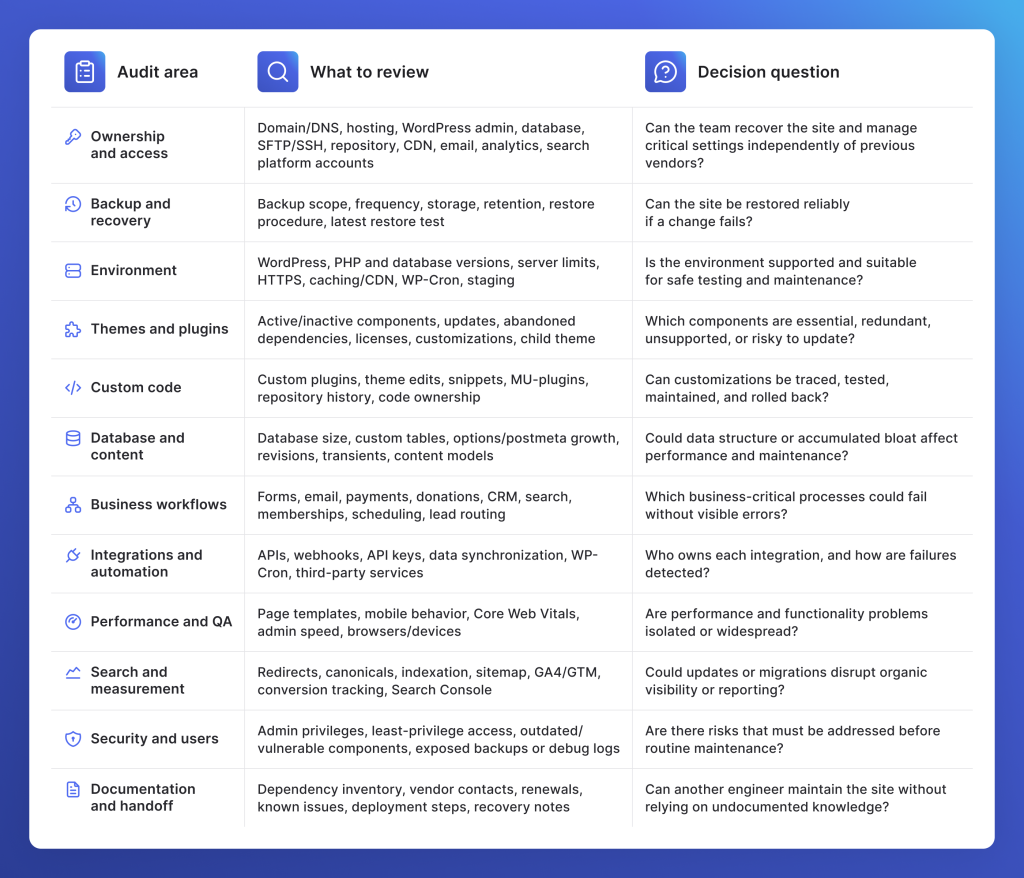
WordPress site takeover checklist
Use this checklist to evaluate the website’s infrastructure, code, integrations, and operational readiness before taking responsibility for future changes.
Turn audit findings into maintenance decisions
Completing the checklist should produce more than an inventory of technical issues. Each finding needs an owner, a priority, and a clear implication for future maintenance.
Classify the results into three groups:
Immediate blockers: Missing critical access, unreliable recovery, exposed credentials, or failures affecting business-critical workflows. Resolve these before accepting responsibility for routine changes.
Stabilization priorities: Unsupported dependencies, undocumented customizations, recurring performance issues, or missing release procedures. Address these through a defined remediation scope.
Routine maintenance items: Manageable updates, isolated defects, performance improvements, and documentation gaps that can be handled through an ongoing maintenance plan.
The final deliverable should include an ownership map, dependency inventory, prioritized risk register, and recommended scope of work.
A thorough takeover audit also establishes a baseline for accountability. With the site’s existing limitations documented, brands and agencies can distinguish inherited technical risks from issues introduced by subsequent changes, estimate work more accurately, and plan improvements with fewer unexpected dependencies.
Quick fix, stabilization, or rebuild: How to choose the right approach
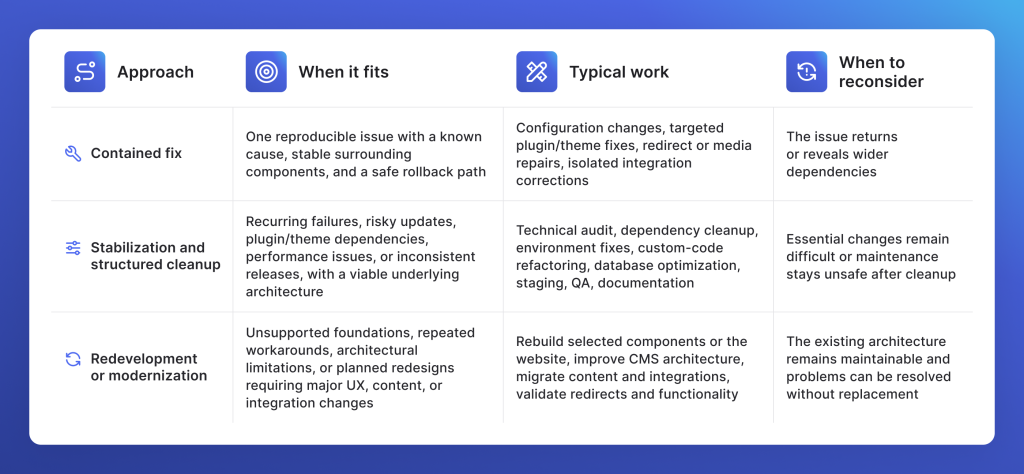
Choosing how to address WordPress website problems requires understanding their scope, dependencies, and impact on business operations. A single reproducible error may need only a targeted fix. Recurring failures may call for WordPress site stabilization, while an architecture that limits essential functionality or future development may justify redevelopment.
The decision should consider five factors: how often problems recur, how many components are affected, whether the site remains maintainable, the business risks involved, and whether its architecture can support planned changes.
Compare your options before committing to a solution
How to make the decision
Start with the smallest intervention that addresses the confirmed cause. A broken redirect, isolated compatibility issue, or incorrect configuration rarely justifies replacing an otherwise stable website. Verify the fix and monitor whether the problem returns.
When WordPress technical debt affects multiple components, stabilization offers a way to preserve working functionality while improving maintainability. This may involve removing unsupported dependencies, restructuring custom code, improving hosting configurations, and establishing reliable testing and deployment procedures.
Redevelopment becomes reasonable when the cost and complexity of maintaining the existing architecture begin to outweigh the value of preserving it. This can happen when essential integrations require repeated workarounds, content management limits business operations, or planned functionality cannot be implemented sustainably.
Redevelopment can also be selective. Rebuilding an outdated theme or content architecture can address structural limitations without replacing every component or abandoning WordPress.
Case study: Redeveloping SOLJET’s outdated WordPress website
SOLJET Construction’s existing website had an outdated design, limited functionality, difficult content updates, and usability issues. GetDevDone redeveloped the website using designs provided by Hiya, implementing seven WordPress pages, interactive features, responsive navigation, and improved content management.
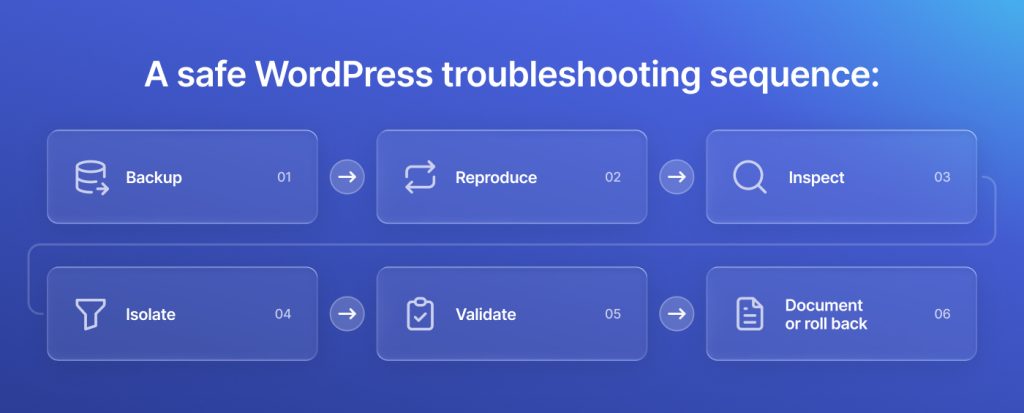
Effective WordPress troubleshooting requires a controlled process that protects the live website while helping teams identify the underlying cause. For brands and agencies maintaining inherited WordPress sites, the goal is to restore functionality without introducing new problems or disrupting business-critical operations.
The following seven-step workflow provides a repeatable approach to diagnosis, testing, and release validation.
1. Preserve the current state
Verify that a recent backup covers the website’s files and database, and confirm how restoration would work. Document the exact symptoms, affected URLs, error messages, timestamps, and recent updates or configuration changes. This establishes a reference point for diagnosis and recovery.
2. Reproduce the issue outside production
Use a staging environment whenever possible to reproduce errors and test plugin or theme conflicts, updates, database cleanup, and custom code changes. Match the relevant production configuration closely enough to make test results meaningful. For business-critical websites, avoid experimenting directly on live systems.
3. Inspect the available evidence
Select diagnostic tools based on the symptoms:
WordPress Site Health: Environment configuration, compatibility concerns, and recommended improvements.
Hosting and server logs: PHP errors, resource limits, failed requests, and application failures.
Integration logs: API responses, webhook failures, missing events, and data synchronization problems.
For PHP-related issues, WP_DEBUG can enable diagnostics, while WP_DEBUG_LOG records errors for investigation. Keep WP_DEBUG_DISPLAY disabled to avoid showing raw errors to visitors. Protect log files from public access and disable temporary debugging settings after diagnosis.
4. Isolate one variable at a time
Test suspected plugins, themes, and customizations methodically, recording which change reproduces or resolves the issue. WordPress Recovery Mode can help identify faulty components when available. If the admin dashboard is inaccessible, targeted SFTP or file-manager changes may be necessary as a fallback, with appropriate backup and recovery precautions.
5. Fix the underlying cause
A cache purge may restore a broken page temporarily, but repeated failures can indicate unresolved code, plugin, database, or hosting problems. Use the diagnostic evidence to determine the appropriate correction and test whether it resolves the original failure without affecting connected functionality.
6. Validate business-critical workflows
Confirm that the affected functionality works as expected. Depending on the change, validation should include forms, email delivery, conversion tracking, redirects, site search, mobile layouts, integrations, and other critical user journeys. A successful technical fix must also preserve the workflows the business depends on.
7. Document the release or roll back
If validation fails, use the established recovery procedure to restore a working state. For successful changes, record the root cause, components modified, test results, deployment details, and remaining risks.
A documented troubleshooting process makes recurring issues easier to investigate and helps future teams maintain the website without repeating the same diagnostic work.
When to bring in WordPress engineering support
Some WordPress website problems can be resolved through routine maintenance or a targeted configuration fix. Specialist engineering support becomes valuable when diagnosis involves multiple technical layers, changes carry significant business risk, or the existing setup makes reliable maintenance difficult.
For brands and agencies managing inherited WordPress sites, the decision should depend on the complexity of the problem, the expertise available internally, and the consequences of an unsuccessful fix.
Signs that specialist WordPress support is needed
Consider involving WordPress engineers when:
The root cause remains unclear. Initial checks of recent changes, logs, and configurations have ruled out obvious causes, but the issue persists or cannot be reproduced reliably.
Custom development creates complex dependencies. The website relies on custom themes, plugins, extensive page-builder modifications, or integrations that require code-level investigation and compatibility testing.
Changes affect multiple technical layers. Resolving an issue requires coordinated work across hosting, PHP runtime, database structures, application code, and third-party systems.
Routine updates carry significant risk. Repeated failures, missing staging environments, or unreliable rollback procedures make even standard maintenance difficult to execute safely.
Performance problems persist after basic optimization. Media compression, caching improvements, and straightforward plugin cleanup haven’t resolved slow page loads or admin operations. Deeper profiling may be necessary to identify expensive queries, inefficient code, or infrastructure bottlenecks.
Business-critical integrations are affected. Problems with forms, payment or donation processing, conversion tracking, CRM synchronization, APIs, or webhooks threaten revenue operations, data accuracy, or client reporting.
Migration or redevelopment requires careful coordination. Content, redirects, analytics, accessibility requirements, and integrations must remain functional while parts of the website or its underlying architecture change.
Additional engineering capacity is needed. Brands may require specialized expertise beyond their internal teams, while agencies may need white-label development support without transferring client strategy or communication responsibilities.
Match the engineering scope to the problem
The appropriate level of support depends on what the initial assessment reveals. An isolated defect may require a narrowly scoped intervention. Recurring failures can justify a stabilization project involving dependency cleanup, testing, and release improvements. Complex migrations or structural limitations may require broader development work.
GetDevDone’s WordPress development services can support these scenarios through technical troubleshooting, custom development, optimization, and ongoing maintenance.
The goal is to establish a scope that addresses the underlying risks without introducing unnecessary redevelopment. Clear ownership, defined validation criteria, detailed documentation, and a maintainable codebase help ensure that the work remains useful after the immediate issue is resolved.
How GetDevDone supports WordPress stabilization and ongoing development
GetDevDone helps brands and agencies resolve WordPress issues, modernize outdated websites, and maintain existing platforms as business requirements evolve. Depending on the site’s condition, the work can range from targeted bug fixes to structured stabilization, CMS redevelopment, or ongoing engineering support.
The approach starts with the existing website: identifying what needs attention, which components remain maintainable, and where technical improvements will deliver the most value.
GetDevDone provides engineering support across the website lifecycle:
WordPress development and customization. Custom themes, plugins, reusable components, and structured content models that support business-specific functionality and make everyday content management easier.
Troubleshooting and maintenance. Bug fixing, core/theme/plugin updates, compatibility improvements, and ongoing technical support to address existing issues and reduce maintenance risks.
Performance and technical optimization. Improvements to loading speed, caching, responsiveness, accessibility, and technical SEO foundations, supported by performance analysis and testing.
Migration and modernization. Legacy code cleanup, CMS migration, and redevelopment of outdated components or website architecture when targeted improvements can no longer meet technical or business requirements.
Quality assurance and release support. Functional testing, responsive and cross-browser validation, accessibility checks, staging, deployment coordination, and documentation for future maintenance.
These capabilities extend beyond isolated WordPress errors. GetDevDone’s website development services also cover broader website optimization, migration, modernization, and post-launch support. Depending on the scope, GetDevDone offers fixed-price projects, time and materials (T&M), team extension, and monthly support retainers.
Frequently asked questions about common WordPress problems
The most common WordPress problems include plugin and theme conflicts, critical errors, database connection failures, slow performance, broken URLs, missing media, and malfunctioning forms or integrations. Updates and hosting configurations can also cause website disruptions.
These WordPress website problems may share symptoms despite having different causes. For example, a blank page could result from incompatible PHP code, a plugin conflict, or a server failure. Start by reviewing recent changes and available logs. Recurring failures across multiple components may require a broader technical assessment.
Start with a WordPress site audit covering access, ownership, backups, and recovery options. Confirm control over hosting, domain settings, the WordPress dashboard, database, and relevant third-party services.
Next, review staging availability, recent updates, active plugins and themes, custom code, integrations, and existing documentation. Verify that the site can be restored before making changes.
For an inherited WordPress website, this assessment reveals which components can be maintained safely and which require further investigation. It also helps establish responsibility for existing issues before new development or maintenance begins.
No. Plugin count alone does not reliably predict website performance. A plugin’s execution cost, database queries, frontend scripts, and interaction with other components matter more than the total number installed.
WordPress plugin conflicts can arise from overlapping functionality or incompatible dependencies, while WordPress performance issues may result from inefficient code, hosting limitations, or resource-intensive background processes.
Use performance profiling to identify actual bottlenecks before removing plugins. A well-maintained site with numerous lightweight plugins may perform better than one with only a few resource-heavy components.
A WordPress critical error or White Screen of Death (WSOD) can result from PHP fatal errors, incompatible plugins or themes, custom code, exhausted memory, or server-level failures.
These symptoms do not identify the underlying cause on their own. WordPress Recovery Mode may provide temporary dashboard access and information about the failing component. PHP and server logs can offer additional diagnostic evidence.
Begin WordPress troubleshooting with recent-change reviews and reversible checks. If failures persist or involve multiple components, investigate compatibility and application dependencies before applying further fixes.
Testing plugin conflicts directly on a live website carries risks, particularly when forms, payments, or other business-critical functions depend on the affected components.
A safer WordPress troubleshooting checklist starts with a verified backup and a working rollback procedure. Reproduce the issue in staging where possible, then isolate suspected plugins or themes individually. WordPress Recovery Mode may help restore administrative access after certain fatal errors.
When staging is unavailable, limit production changes to carefully controlled actions with a clear recovery path. Validate all affected functionality before considering the issue resolved.
WP_DEBUG should be used for temporary diagnostics when PHP errors or unexpected WordPress behavior require investigation, preferably in a development or staging environment.
When enabled, WP_DEBUG_LOG can record diagnostic messages, while WP_DEBUG_DISPLAY controls whether those messages appear on pages. Publicly displaying raw errors can expose sensitive technical information, so production-facing debugging requires particular care.
WordPress troubleshooting should prioritize protected logs and controlled testing. Disable temporary debugging settings after investigation and ensure diagnostic files are not publicly accessible.
Yes. A slow WordPress site can often be improved without redevelopment once the actual performance bottlenecks are identified.
Measure page loading, server response times, and database activity before making changes. Oversized media, inefficient caching, unnecessary scripts, plugin overhead, and hosting limitations are common areas to investigate.
More persistent WordPress performance issues may involve database complexity or accumulated technical debt. Start with targeted improvements and measure their impact. For detailed techniques, see our guide on optimizing WordPress performance.
WordPress site stabilization becomes appropriate when failures recur, routine updates create new problems, or changes across several components become difficult to manage safely.
Warning signs include undocumented dependencies, missing staging or rollback procedures, and issues involving application code, hosting, databases, and integrations simultaneously. Accumulated WordPress technical debt can make isolated fixes increasingly expensive and unreliable.
A structured cleanup should address the dependencies behind recurring failures, establish safer release practices, and document the system. The objective is to restore maintainability while retaining components that still meet business requirements.
A rebuild becomes reasonable when the existing architecture prevents necessary functionality, creates ongoing maintenance difficulties, or depends heavily on unsupported components and repeated workarounds.
When evaluating when to rebuild a WordPress site, consider future content requirements, integrations, user experience, and the cost of maintaining the current setup. A major redesign or migration may also justify redevelopment.
Website age alone is insufficient reason to rebuild. Targeted modernization or stabilization may preserve useful components at lower cost and risk. The decision should follow a technical audit and a clear business case.
Ongoing WordPress maintenance should include controlled core, theme, and plugin updates, verified backups, recovery procedures, monitoring, bug fixes, and performance checks.
Maintenance should also cover functional QA, security-related updates, integration validation, and testing across browsers and devices where relevant. Changes need documented release procedures, clear ownership, and a rollback plan.
Recurring WordPress maintenance issues often become harder to resolve when updates are applied without testing or documentation. A structured maintenance process helps teams identify problems earlier, maintain reliable functionality, and introduce improvements without unnecessary disruption.
Discover our latest case study featuring the Dinghy Daily Charter project. See how our expert WordPress team developed a mobile-first, responsive website to engage and convert visitors.
Talk to a commerce advisor to define the right architecture, platforms, and growth model for your business.
Get guidance on configuration, scalability, and compliance — tailored to your market and goals.