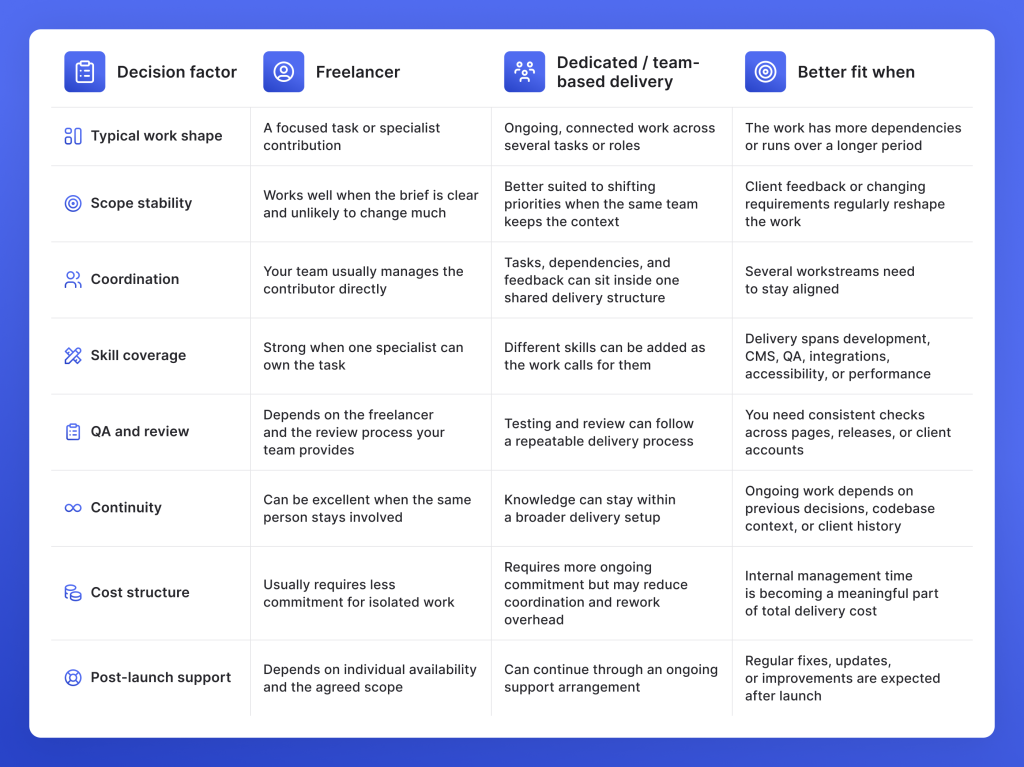
Freelancers are a better fit for narrow, fixed-scope work, while dedicated or team-based delivery works better for ongoing projects that require coordination, continuity, and broader skill coverage.
Choose freelancers for self-contained tasks with stable requirements, limited dependencies, and straightforward internal review
Choose a dedicated or team-based delivery model for recurring work, overlapping client projects, changing priorities, and multi-role delivery
Compare total delivery cost by factoring in coordination, onboarding, QA, rework, context transfer, unused capacity, and post-launch support
Consider team extension, staff augmentation, managed delivery, or a white-label development partner when a traditional dedicated team does not match how you want to manage the work
Evaluate development partners by reviewing relevant project experience, delivery ownership, QA processes, staging and status visibility, security and IP controls, handoff, and support
Dedicated team or freelancer: Which one fits the work?
There is no universal winner in the dedicated development team vs. freelancers debate for website development services. For a digital agency, a freelancer can be the better fit for a focused, well-defined task, while a dedicated or coordinated team becomes more useful when client projects overlap, revisions keep coming, launch deadlines compete, and continuity matters after release.
For a digital agency, the difference becomes clearer once multiple client projects start moving at the same time. Revisions pile up, launch dates get closer, and post-launch requests compete with new work. The dedicated team or freelance developer decision also has to account for the coordination, context switching, review, and follow-up your team handles internally.
A dedicated website development team is not the only alternative. Depending on how much day-to-day delivery management you want to own, team extension or a managed white-label web development partner may be a better fit.
The dedicated development team vs. freelancer choice gets easier once you look at the shape of the work in front of you.
A freelancer can be the right call for a focused task with clear boundaries, limited dependencies, and a clean handoff. That could mean fixing a specific front-end issue, building a small feature, or bringing in a specialist for a short review.
A team-based setup becomes more useful as delivery gets more layered. Several client projects may be moving at once. Feedback changes the scope. Development starts touching CMS work, integrations, QA, performance, and support. At that point, continuity and coordination carry more weight because more people, decisions, and dependencies have to stay connected.
A dedicated team vs freelance developer comparison works best when you judge each option by the delivery load it creates for your own team. That includes coordination, review, context transfer, QA, and support after launch.
What counts as a dedicated development team?
The term dedicated development team covers several delivery setups. One provider may use it for a stable full-time group assigned to one client. Another may mean team extension, where external specialists join the client’s workflow. It can also describe a managed team that takes on more responsibility for planning, coordination, and delivery.
In this article, dedicated or team-based delivery means a stable group that works with the client over time and retains context across projects, revisions, and releases. That setup can take several forms:
Freelancer: one individual hired for a specific task, skill, or period.
Team extension/staff augmentation: external specialists join the client’s team, while the client keeps ownership of priorities, day-to-day management, and delivery decisions.
Managed or project-based delivery: the provider takes on more coordination around a defined scope, work package, or outcome.
White-label development partner: a delivery partner works behind the scenes under the agency’s client relationship and brand.
That distinction matters when comparing a dedicated team vs. staff augmentation, because ownership can differ even when both involve external specialists.
GetDevDone supports several delivery models, including T&M, fixed-price work, team extension, and recurring support where appropriate. So working with a white-label development partner does not automatically mean hiring one exclusive full-time squad.
When a freelancer is exactly what you need
A freelancer is usually the better fit when the task is narrow, self-contained, and easy for your team to review and integrate.
The work can stand on its own
For a digital agency, that might mean fixing a stubborn layout issue, building a small front-end element, writing a one-off script, or bringing in a specialist for a focused accessibility review.
These tasks have clear boundaries, limited dependencies, and little need for coordination across developers, QA, design, or client systems. They can move from brief to delivery without creating a larger workflow around them.
Your team already owns the delivery process
A freelancer fits well when someone on your side can scope the task, answer questions, review the output, handle integration, and run QA.
In that setup, you are buying a specific skill for a specific period. You are not paying for project management, broader role coverage, or a delivery structure you already have in-house.
You do not need ongoing capacity
Long-term context matters less when the work ends cleanly after approval and handoff. If requests come in only occasionally, reserving ongoing capacity can leave you paying for time you do not use.
That is an important part of the dedicated team vs freelance developer decision. In the wider dedicated teams vs freelancers comparison, even commercially important work can be a strong fit for a freelancer when the scope is fixed, and your agency can comfortably manage everything around it.
When ongoing delivery calls for a dedicated team
A dedicated web development team or delivery partner becomes a stronger fit when the work keeps moving, changing, and expanding across several people or disciplines.
You’re juggling several projects
Agency delivery gets harder to coordinate when multiple client projects overlap, and priorities change from week to week. One launch may need last-minute CMS updates while another project is waiting on integrations, QA, accessibility checks, or performance work.
A stable team helps preserve context across those shifts. People already know the codebase, client preferences, design decisions, and issues that surfaced earlier. That continuity becomes especially valuable when requirements change after review rounds, and the team has to adjust without starting from zero each time.
Capacity needs to flex without rebuilding the bench
When several projects need extra hands at the same time, sourcing and onboarding contributors can become a workload by itself. If that pattern repeats, constantly sourcing and onboarding new contributors can create its own workload.
This is one of the clearest signals for when to hire a dedicated development team or work with a broader delivery partner. A coordinated setup gives the agency a more predictable way to absorb peaks, bring in the right skills, and keep work moving without assembling a new contributor mix for every project.
The work continues after launch
Going live does not end web delivery. Post-launch support may include fixes, maintenance, campaign updates, new pages, integrations, performance improvements, or ongoing CMS work.
For agencies that also need white-label delivery, consistent process and handoff matter just as much. The end client sees the agency, so the behind-the-scenes delivery setup has to stay reliable and easy to manage.
A team-based model still needs enough ongoing demand to justify the commitment. For intermittent work, it can leave too much unused capacity. It also depends on timely priorities, approvals, and clients’ feedback.
Dedicated team vs. freelancers: 8 differences that shape delivery
The difference between freelancers and a dedicated team becomes much clearer once you look at how the work moves from brief to launch. Coordination, dependencies, QA, continuity, and support all shape how smoothly that delivery process runs.
1. Skill coverage matters when the work is connected
A contained front-end task, a focused CMS adjustment, or a specialist review can sit comfortably with one freelancer when the scope is clear, and the surrounding dependencies are limited.
The setup changes once one deliverable starts pulling in several disciplines. A landing page may begin as front-end work, then require CMS configuration, a third-party integration, responsive QA, accessibility fixes, and performance tuning before launch. Each layer affects the next, which makes coordination part of the delivery itself.
A dedicated web development team gives the agency broader skill coverage around that shared deliverable. Front-end, CMS, integration, QA, accessibility, and performance work can stay connected as requirements evolve instead of being managed as separate contributions.
That broader setup only earns its keep when those dependencies actually exist. If the agency already has QA, technical oversight, and the surrounding expertise in-house, one freelancer can still be the cleanest choice.
For a self-contained contribution, one specialist may be enough. When several disciplines shape the same release, coordinated skill coverage gives the agency fewer handoffs to manage and fewer gaps between roles.
2. Continuity becomes more valuable with every release
Projects collect history fast. A component was built a certain way for a reason. The CMS has quirks nobody wants to rediscover. The client has preferences that never made it into the brief. A bug from two launches ago still explains why part of the codebase looks the way it does.
When the same people stay close to the work, that context travels with them. They know which decisions are flexible, which constraints are real, and where a “small change” is likely to have knock-on effects. That makes every new round of work easier to pick up.
A long-term freelancer can build exactly that kind of knowledge and may become the person who understands the project best. The weak point in a dedicated development team vs. freelancer setup appears when most of the codebase context and client context live with one individual.
If that person becomes unavailable, the agency may suddenly have to reconstruct months of decisions during a handoff. A broader team can spread that knowledge through shared documentation, reviews, project tools, and overlapping involvement.
That lowers the bus factor and makes continuity more resilient. For recurring agency work, where releases build on everything that came before, that resilience can save a lot of relearning.
3. Fewer loose ends, clearer ownership
One freelancer is easy to manage. Three or four working on the same client account can turn the agency into the switchboard.
A designer sends an update. The front-end developer is waiting on assets. The CMS specialist needs clarification. QA finds an issue that touches someone else’s work. Meanwhile, the client sends another round of feedback, and someone on the agency side has to work out who owns what, chase the right person, and keep the launch from drifting.
A coordinated team reduces that drag. Tasks, feedback, and dependencies can sit inside shared project tools and one workflow, making ownership easier to follow and escalation clearer when something gets stuck.
That is where dedicated teams in web development can make day-to-day delivery easier. The value comes from having fewer loose ends for the agency to manage and a clearer view of what is moving, what is blocked, and what needs a decision next.
4. QA needs a clear definition of “ready”
“Ready to launch” should mean more than finished development.
The code has been reviewed. Layouts hold up across screen sizes and browsers. Forms, links, filters, and interactions work as expected. Accessibility issues have been checked. Performance has been tested. The latest version is sitting on staging, where the agency and client can review it before production.
That sequence creates a release standard instead of treating QA as a final sweep at the end.
A freelancer can absolutely work to that standard. Quality does not come from the company type. It comes from having the right checks, enough time to run them, and clear ownership of what happens when an issue appears.
A dedicated web development team can make that standard easier to carry from one release to the next. Code review, functional QA, responsive and cross-browser testing, accessibility, performance checks, staging, and launch procedures can live inside the same delivery system instead of being redefined for every task.
For an agency, that consistency matters when several pages, releases, or client accounts need to meet the same bar before they go live.
5. Capacity should flex with the workload
Agency workloads can change fast. Two launches can land in the same week, a client can add scope late, or a support request can pull attention away from planned work.
A provider can make capacity planning easier by reallocating people or adding role coverage when demand grows. That helps when the agency needs extra front-end, QA, CMS, or integration support without running a fresh search for every gap.
There are limits. Specialized roles still depend on availability, and anyone joining mid-project needs onboarding and context before they can contribute effectively. A provider cannot make that ramp-up disappear.
With freelancers, the agency may need to own that process directly:
sourcing the next person;
checking availability;
onboarding them;
connecting their work to the rest of the project.
If workload peaks keep returning, it may be worth considering when to hire a dedicated web development team or work with a broader delivery partner that can offer more flexible role coverage.
6. Scope changes need a way into the plan
Web projects rarely stay exactly as scoped. A new page, integration issue, or client revision can affect several parts of the build at once.
With one freelancer, changes are usually easy to manage when the work is contained. Once several specialists are involved, someone has to trace the impact across tasks, timing, and dependencies.
A dedicated team keeps those changes inside one delivery workflow, with shared priorities, estimates, and acceptance criteria. The agency still controls what gets approved, but has fewer separate handoffs to reconcile.
Freelancers can work just as effectively when the agency already has strong change control. The real difference is who owns the coordination when scope starts moving.
7. Security starts with the rules around access
Before anyone touches the codebase, the basics should already be settled: NDA and confidentiality terms, IP ownership, repository access, credential rules, and who is accountable for delivery under the contract.
During the project, access should stay limited to what each person actually needs. Repositories, production environments, client data, and shared credentials should have clear owners. Data minimization matters here too, especially when the work involves customer information, analytics, or third-party systems.
The same discipline should carry through to offboarding. Access gets removed, credentials are rotated where needed, project assets stay with the right owner, and the handoff leaves no uncertainty over code, documentation, or IP.
A professional freelancer can work within this kind of framework just as effectively as a provider. In a dedicated development team vs. freelancers comparison, the practical difference is often who sets up and maintains those controls across the engagement. A broader delivery partner may already have that structure in place, while an agency working with an individual contributor may need to define more of it itself.
8. Post-launch work needs its own plan
Launch does not close the work. A week later, there may be a bug fix or CMS change. Next comes a plugin or theme update, a campaign request, a performance dip, or an integration that starts behaving differently after a third-party change.
Those requests are easier to handle when support is planned as part of delivery rather than improvised after launch. The person or team stepping in already knows the codebase, the CMS setup, the launch history, and the decisions that shaped the site. That continuity cuts down the time spent reconstructing context before the actual fix can begin.
A retained team can carry that knowledge into maintenance, updates, performance monitoring, and follow-up development. A freelancer can do the same when post-launch scope and availability are agreed upfront.
For agencies comparing dedicated teams vs freelancers, support deserves a separate decision because the work after launch has its own rhythm, priorities, and capacity needs. The cleaner the support setup is from the start, the less context gets lost between release and the next request.
What a freelancer or dedicated team costs
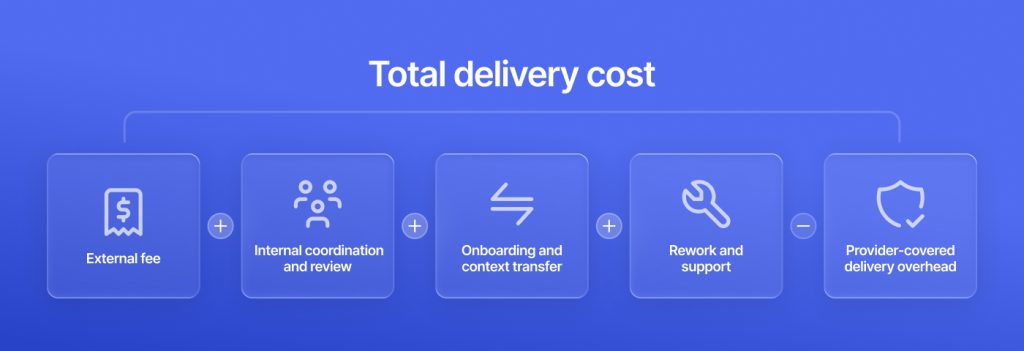
A quote tells you what the external work costs. It does not tell you what it will cost your agency to get that work all the way through delivery.
That distinction matters in any dedicated development team vs. freelancers comparison. A freelancer with a lower quoted hourly rate can look inexpensive on paper, yet the agency may still be spending internal hours on scoping, answering questions, coordinating dependencies, reviewing work, consolidating client feedback, and arranging QA. Change the contributor, and onboarding and context transfer enter the picture too.
A useful way to frame the calculation is:
The external rate is only the first line. The rest tends to show up in places like:
time spent turning client feedback into clear development tasks;
project management across several contributors;
onboarding when a new person joins midstream;
QA, integration checks, or rework outside the original scope;
post-launch fixes and support;
context lost when work moves between contributors.
A coordinated provider can absorb part of that workload when project management, QA, staging, or support sit inside the engagement. The commercial terms still need a close look. Minimum commitments, notice periods, retained capacity, and support scope can all change the total.
Utilization creates another cost issue. A dedicated setup can become expensive when the workload comes in short bursts and paid capacity sits unused between requests. For a contained task that your team can scope, review, and integrate without much overhead, a freelancer may leave you with the lower total bill.
The dedicated team cost vs freelancer cost calculation shifts as the work becomes more continuous. If every project brings another round of onboarding, coordination, feedback management, QA, and context switching, those internal hours start adding up.
Neither engagement model comes with an automatic cost advantage. The useful number is the full cost of getting the work scoped, coordinated, reviewed, launched, and supported under the terms of the actual engagement.
Freelancer, dedicated team, team extension, or project-based partner: Which development model fits your delivery setup?
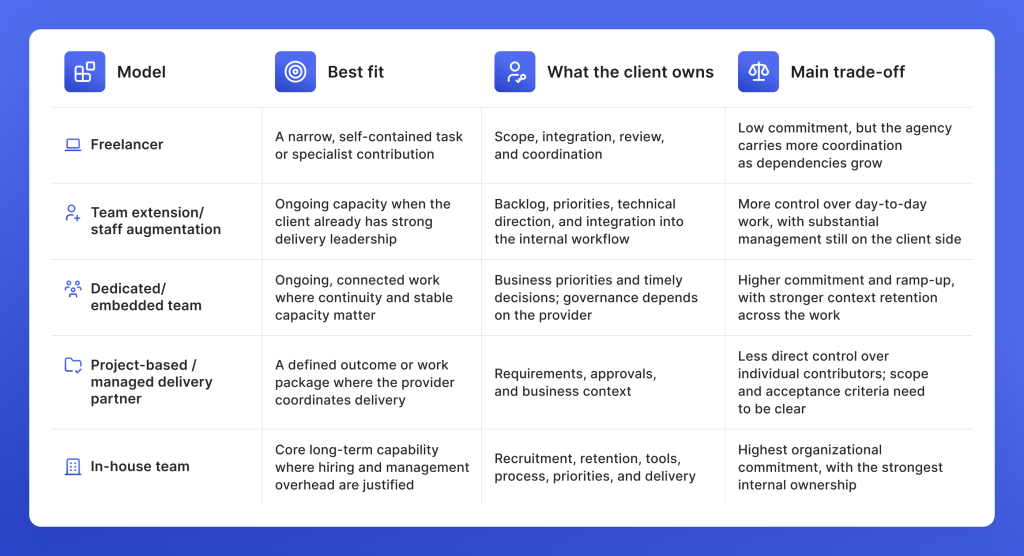
A freelancer, team extension, dedicated team, and managed delivery partner solve different delivery problems. The clearest way to choose is to look at the shape of the work and decide how much coordination, management, and continuity you want to keep on your side.
The dedicated development team vs. freelancers comparison covers only part of the decision. A dedicated team vs. staff augmentation setup differs mainly in who runs the day-to-day work. Team extension gives the client more direct control, while a dedicated or managed setup can shift more coordination to the provider.
The same applies to a dedicated team vs. an in-house team decision. An in-house team gives the company full ownership of people and process, but it also comes with recruitment, retention, tooling, and management responsibility.
GetDevDone supports several delivery routes, including T&M, fixed-price work, team extension, and recurring support where the engagement calls for it. That gives agencies room to choose the operating model around the work instead of forcing every project into an exclusive dedicated-team setup.
What to check before you choose a development partner
Choosing a development partner takes more than scanning a portfolio and comparing estimates. The useful signals are in how the partner works: how they scope, coordinate, test, handle change, protect access, and support the project after launch.
If you are figuring out how to choose a dedicated development team or a white-label development partner, these questions give you a much clearer picture of what day-to-day delivery will look like.
1. Can they show work that matches your level of complexity?
Look for relevant websites, CMS, and front-end projects with similar integrations, content structure, interaction depth, or performance requirements. A polished homepage tells you very little about how the partner handles a complicated implementation.
2. Who owns scope, estimates, priorities, and escalation?
Get specific. Who turns requirements into tasks? Who estimates the work? Who sets priorities when several requests compete? Who steps in when delivery gets blocked?
3. Which roles are actually part of the engagement?
Ask which people are included from the start, which roles are shared across projects, and which specialists are added only when needed. “Full team” can mean very different things from one provider to another.
4. How do they handle messy handoffs and changing requirements?
Design files are not always complete. Breakpoints get missed. Client feedback arrives late. Ask how the partner handles unclear requirements, design-to-development handoffs, scope changes, and change requests once work is already underway.
5. What does QA actually include?
Ask for the real checklist: functional QA, responsive testing, cross-browser checks, accessibility, performance, integration testing, regression testing, and launch validation. “We test everything” is not specific enough.
6. How will you see progress?
You should know how status visibility works before the project starts. That may include shared project tools, staging links, demos, status reports, and clear acceptance checkpoints. GetDevDone’s website development process offers a useful reference for what structured delivery can look like.
7. What happens when capacity changes?
Ask how the partner handles workload spikes, role changes, or contributor unavailability. Capacity continuity depends on availability, onboarding, and how well project knowledge is shared.
8. How are access, IP, and confidentiality handled?
Cover repository ownership, credentials, permissions, NDA terms, IP ownership, offboarding, and who removes access when someone leaves the project.
9. What happens after launch?
Clarify what is included in fixes, maintenance, documentation, support, handoff, and future updates. A clean launch can still leave plenty of work behind.
10. Can they fit into your agency workflow?
For agency partnerships, this can be decisive. Ask whether the partner can work inside your tools and processes, follow your communication model, and stay white-label when the client relationship needs to remain fully under your brand.
GetDevDone helps agencies and brands build, improve, and scale websites with expert teams across website development, web design, eCommerce, and AI engineering. For agencies, we provide additional development capacity for overlapping client projects and ongoing delivery without expanding in-house teams.
When the fit is strongest
The model makes sense when client projects overlap and the agency needs predictable timelines, clear scope, and a structured way to handle changing workloads.
That may include CMS and front-end implementation, integrations, migrations, performance and accessibility work, maintenance, or post-launch support. Projects that require staging, QA, maintainable code, SEO-friendly implementation, and a clear handoff also benefit from having those steps connected inside one delivery process.
For agencies that want to keep strategy and client communication in-house, GetDevDone can also work as a white-label development partner, supporting implementation behind the scenes while the agency remains the face of the client relationship.
The engagement can match the work
Agencies looking to outsource web development do not have to commit to one delivery model. GetDevDone supports T&M, fixed-price work, team extension, and recurring support where it fits the engagement.
That means working with GetDevDone does not automatically mean assigning one exclusive dedicated web development team full time. The setup can reflect the project scope, workload, and amount of delivery management the agency wants to keep internally.
When a freelancer may be enough
For one small, isolated task with few dependencies and straightforward internal review, a capable freelancer may be the simpler choice.
GetDevDone becomes a more relevant option when the agency or brand needs repeatable delivery across overlapping projects, broader role coverage, structured QA and staging, white-label execution, or continuity after launch.
Need a smooth design-to-launch?
Website development with fast turnaround and production-ready delivery
A quick way to choose the right partner and delivery model
Choose a freelancer when the work is clearly contained, and your team can comfortably own everything around it.
A freelancer is the stronger fit when:
the task can be delivered independently;
scope and acceptance criteria are stable;
one specialist can cover the work;
your team can review, integrate, and approve the result;
little post-launch continuity is needed.
Choose a dedicated, team-based, or managed delivery model when the work is recurring, spans several client projects, or depends on several roles staying coordinated over time.
That setup fits better when:
work is recurring or spread across several client projects;
priorities and requirements keep changing;
several skills or dependencies need coordination;
QA, staging, handoff, and support need a repeatable process;
retained context matters across releases;
internal coordination is starting to consume too much agency time.
Neither option fits every project. A freelancer can be the cleaner choice for focused work with light coordination. A coordinated team becomes a stronger fit when recurring delivery brings more dependencies, retained context, QA, support, and internal management overhead.
Dedicated teams vs freelancers – FAQs
No. A dedicated team makes sense when the work carries enough duration, coordination, and continuity to justify a broader delivery setup.
For a short project with stable scope and one clear owner, a freelancer can be the cleaner choice. Once several roles touch the same work, priorities keep moving, or the project continues through multiple releases, a dedicated team can reduce the coordination load.
In a dedicated development team vs freelancers comparison, project scope and duration matter more than the label attached to the provider. Choose the setup that matches how much coordination the work actually creates.
A digital agency should use a freelancer when the work has a fixed scope, depends on one specialist skill, and can be reviewed and integrated internally.
That could be a contained front-end fix, a CMS adjustment, a one-off script, or a specialist review. The agency should already have someone who can brief the task, answer questions, review the output, and handle QA.
In a dedicated team vs freelance developer decision, a freelancer fits best when the agency already owns the delivery structure around the task. That keeps the engagement lean without adding coordination the work does not need.
The setup starts to strain when agency delivery depends on too many separate contributors and too much context sits in individual conversations.
Typical signs include overlapping projects, repeated onboarding, changing priorities, several specialists touching the same release, and post-launch support pulling people back into earlier work. Coordination starts taking up more internal time, while continuity becomes harder to protect.
A dedicated web development team can help when the agency needs one delivery structure across recurring work, support, and follow-up releases. The shift can happen at any agency size. Workload shape and coordination pressure are the stronger signals.
The difference sits in how management responsibility is divided.
With staff augmentation or team extension, external specialists work inside the client’s existing structure. The client owns the backlog, priorities, technical direction, approvals, and day-to-day coordination.
A dedicated team can operate with a broader delivery structure, depending on the engagement. The provider may coordinate tasks, role coverage, delivery dependencies, and continuity while the client keeps ownership of business priorities and key decisions.
In a dedicated team vs staff augmentation comparison, team extension gives the client more direct control. A dedicated setup can shift more coordination to the provider.
It can be, depending on the workload and how much delivery overhead sits inside the agency.
Freelancers can keep costs low for isolated work with light coordination. The calculation changes when the agency spends hours on onboarding, project management, QA, feedback consolidation, rework, and context transfer between contributors.
In a dedicated teams vs freelancers comparison, total delivery cost matters more than the headline hourly rate. Team-based delivery can become more economical when the same coordination work repeats across ongoing projects.
Utilization still matters. If paid capacity sits unused between requests, a dedicated setup can cost more.
Management depends on the engagement structure agreed with the provider.
The client may own the backlog, priorities, approvals, and product or technical direction while the provider coordinates execution. In a more managed setup, the provider may also handle estimates, task coordination, dependency management, and escalation.
The important part is to define that split before work starts. Everyone should know who sets priorities, who approves changes, who resolves blockers, and who keeps delivery moving when several tasks compete for attention.
A dedicated development team works best when client ownership and provider coordination are clearly separated, with no gaps between decision-making and execution.
Quality depends on the process agreed for the work, not on whether the provider is a freelancer or a company.
A freelancer can deliver strong code review, testing, and QA when those responsibilities are clearly defined. With a development partner, functional QA, responsive and cross-browser testing, accessibility, performance checks, staging, and launch validation can sit inside one repeatable delivery process with clearer ownership.
In a dedicated development team vs. freelancers comparison, accountability comes down to who owns each check and who resolves issues when they appear. Ask for the QA scope and ownership model before work starts.
Before you hire a dedicated web development team, agree on how the engagement will run from scope through handoff.
Define roles, estimates, priorities, communication, QA, change requests, approvals, security, IP ownership, repository access, credentials, support, and offboarding. The agency should also know how progress will be shown, who resolves blockers, and what happens when capacity needs change.
A detailed agreement gives both sides a shared operating framework. It also makes scope changes, support requests, and ownership decisions easier to handle once delivery is already moving.
Post-launch support depends on availability, retained context, and the support terms agreed before release.
A freelancer can handle maintenance, bug fixes, updates, and follow-up work effectively when scope and availability are clear. A team-based partner can place that work inside an ongoing support setup and keep project context available across CMS changes, performance work, integration issues, and new releases.
In a dedicated teams vs freelancers decision, support should be evaluated separately from the initial build. If the site will need regular attention after launch, continuity and response capacity should be part of the engagement from the start.
A small agency can benefit from a dedicated web development team when delivery complexity and workload create more coordination than the internal team can comfortably absorb.
That may happen when client projects overlap, several skills need to stay aligned, deadlines compete, or capacity changes from week to week. A freelancer can still be the cleaner choice for isolated tasks with stable scope and straightforward review.
Agency size does not decide the model. Look at delivery complexity, workload, coordination needs, and capacity pressure. A broader team setup becomes worthwhile when those demands start consuming too much internal time.
Headless CMS for enterprises: buyer's guide to top scalable platforms for high-traffic, multi-team ops with proven architecture, pricing tiers, and rollout plan
Talk to a commerce advisor to define the right architecture, platforms, and growth model for your business.
Get guidance on configuration, scalability, and compliance — tailored to your market and goals.