

- Guide, Website development services
- 10 min read
Taking Web Accessibility a Step Further: What’s New in WCAG 2.2?
The new WCAG 2.2 success criteria tried and tested, and how they impact web accessibility, compliance, usability, and inclusive design.
Launch, migrate, or optimize your Magento store with GetDevDone eCommerce engineering: custom features, API integrations, accessibility, and performance tuning.

TL;DR
Magento is an eCommerce development platform that combines centralized store management, built-in marketing and SEO features, mobile-friendly storefronts, and flexible integrations for growing online stores.
Before we start our journey into Magento, there is one thing we can tell you for sure: you are here because you want your online store business to succeed. It doesn’t matter whether you are about to launch your first online store or you want to improve an existing one; you have certain needs that the Magento platform is set to satisfy. As it was created purely for managing online stores, its main purpose is to list and sell the products in your stock. However, a competent Magento development team can create additional pages for your store and integrate them with third-party applications that will create a richer experience for your customers.
Why is Magento so popular with eCommerce entrepreneurs? Well, one thing is always true: Magento has a great number of pros that help entrepreneurs all over the world take their business to the next level of excellence. Let’s have a glimpse at the main factors for success.

Reliable eCommerce solutions for smooth scaling.
Order NowMagento allows you to use the dashboard to manage everything related to your online store in one place: product prices, categories, sales and discounts, shipping prices, etc. Using the dashboard, you can easily manage your products, add reviews and overviews, increase the number of products available, and expand your online store. If you have several stores, fear not: the Magento dashboard can manage them all in one place.
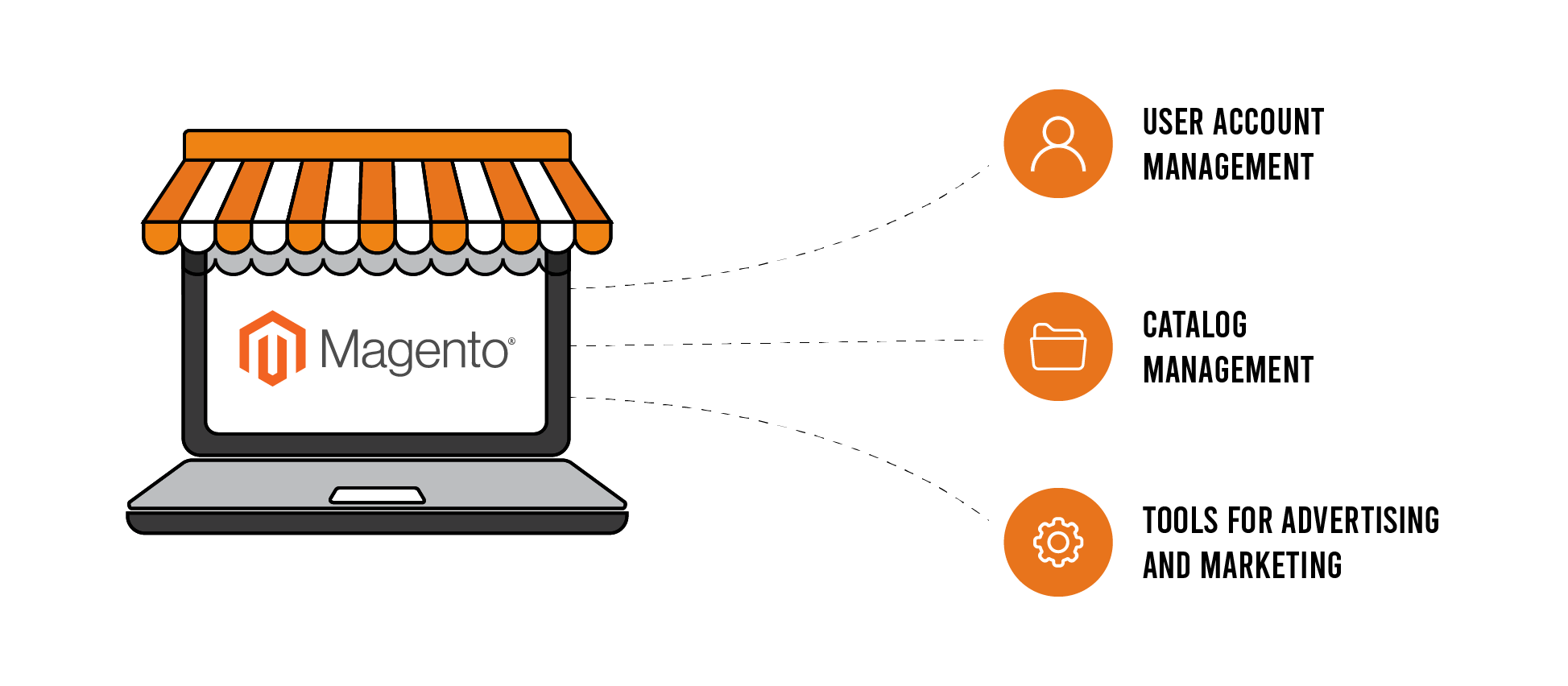
You can set different user roles to manage their access to certain parts of the website and/or dashboard by granting read/write permissions as necessary. This is often considered to be one of the main features of Magento as it makes the process of managing access effortless.
With Magento, you can create sales, coupons, offer supplementary items and free shipping under certain conditions, send emails with a particular CTA (Call To Action), and even create one-pagers for campaigns. Moreover, you can encourage users to browse related products by adding prompts to product and/or checkout pages. Additionally, you get detailed reports on your store’s performance to help you design an efficient marketing campaign.
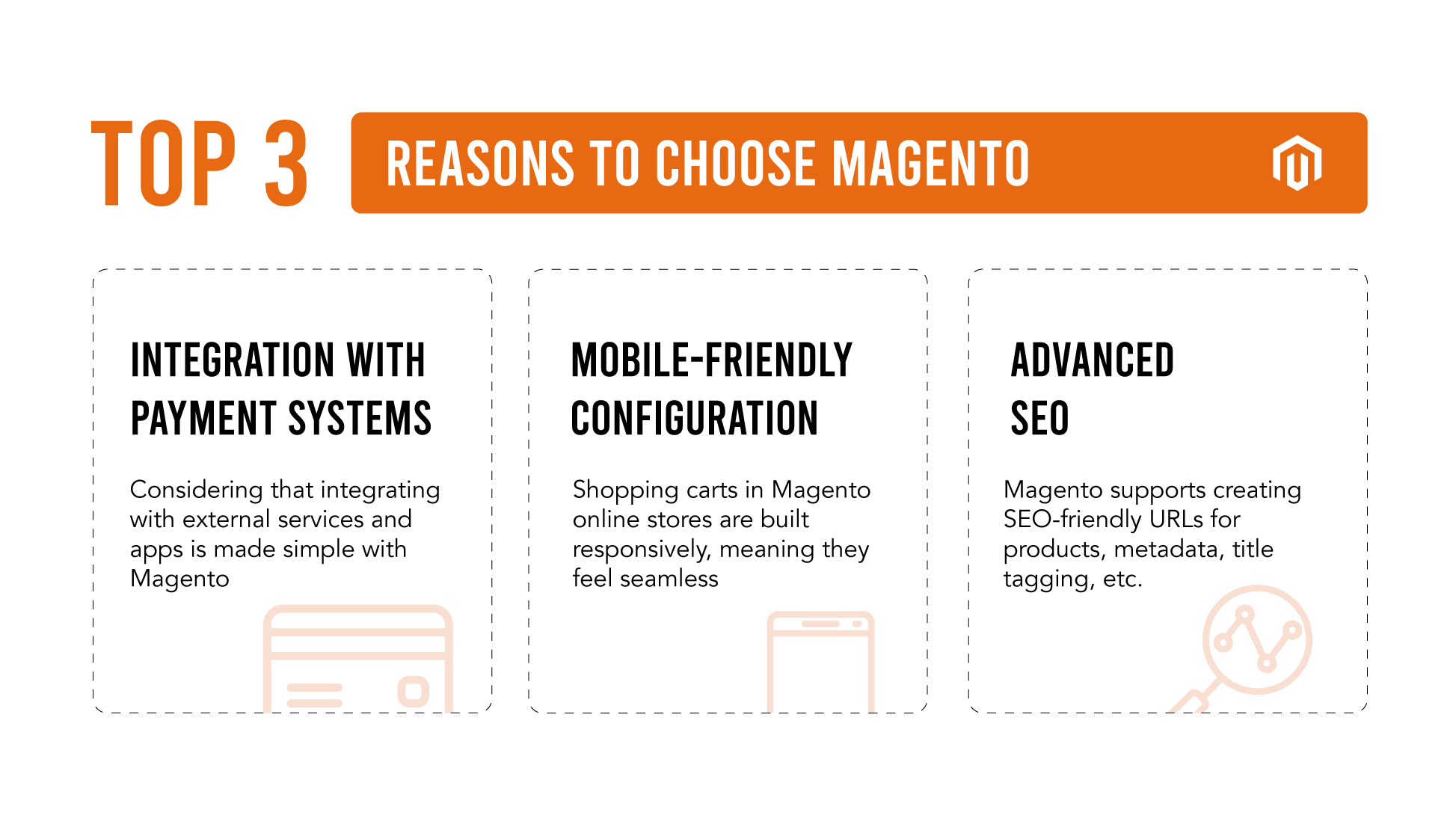
Considering that integrating with external services and apps is made simple with Magento, you are free to choose whichever payment system you find the best and integrate with it as fast as possible, be it PayPal or anything else. On top of payment systems, you can integrate your store with eBay, MailChimp, Google Analytics, and many more.
Magento supports creating SEO-friendly URLs for products, metadata, title tagging, etc. Additionally, Magento provides online store owners with various ways to increase the number of internal links. Besides that, you can create a list of the most popular items in your store. You can be sure about one thing: Magento was created to be SEO-efficient, so it is guaranteed to satisfy your SEO needs.
Considering that smartphone users browse mobile eCommerce websites for an average of five minutes, you need to stun them with a seamless and intuitive Magento user experience within the first seconds of their visit. For instance, shopping carts in Magento online stores are built responsively, which means that they feel seamless regardless of the device used.
A team of true Magento professionals can help you take advantage of all the Magento benefits listed above and many more. Choosing such a team has to be a wise decision. At GetDevDone, we believe that our mission is to make your eCommerce enterprise successful.
We make sure that each and every Magento theme can be easily customized later on. Basic integration includes coding of Checkout, Cart, My Account, Search page, Catalog, CMS page, and 404 pages. We develop a PSD to Magento theme based on your designs.
We can handle any scope of work and adapt to any process. Feel free to unleash your creativity, then give us the Magento theme you’ve chosen, and we’ll convert the PSD to Magento flawlessly. Our engineers make sure your final build runs smoothly, stays stable in production, and is ready for real-world use.
If you have a request that doesn’t involve an entire team (for instance, when only a front-end developer is required), we can assist you with this as well.
Our Magento development company does more than Magento theme creation; we also build modules, integrate external extensions, perform migrations, etc. The Magento Marketplace is extremely diverse, with thousands of custom extensions available. We offer the latest best-practice extensions to extend your store’s functionality.
Are you ready to shape the future of your eCommerce enterprise? Feel free to reach out to us to get answers to any questions you may have, or to make a step towards starting a fruitful business relationship with us.
Magento can still be a good choice in 2026, but mainly for stores that need more control than a simpler hosted platform can provide. The current ecosystem should be understood as Magento Open Source for free, flexible self-hosted commerce and Adobe Commerce for larger commercial implementations with enterprise features and Adobe support.
It is not the easiest or cheapest route for every online store. Magento usually makes more sense when the business needs complex catalog logic, multiple storefronts, custom checkout behavior, integrations with back-office systems, or long-term platform ownership. For a small store with a simple catalog and limited technical support, Shopify or WooCommerce may be a more practical starting point.
The important shift is this: Magento is less of a quick store builder and more of a development platform for ecommerce systems that need room to grow.
Magento is usually the best fit for stores with operational complexity, not just stores that want to sell a few products online. It works well when the catalog, pricing, permissions, shipping, promotions, or integration logic would be awkward to manage inside a simpler platform.
Good-fit examples include:
Magento can be too heavy for a small store that only needs a standard theme, simple product pages, and basic checkout. In that case, the extra development, hosting, maintenance, and QA work may not pay off.
A Magento online store usually costs much more than the software license suggests because most of the budget goes into development, setup, integrations, QA, and long-term maintenance. Magento Open Source may be free to use, but a production-ready store still needs planning, hosting, design implementation, extension review, checkout setup, payment and shipping configuration, testing, and security updates.
The main cost drivers are usually:
For agencies handing off Magento development work, the biggest budget risk is unclear scope. If the design, catalog rules, integrations, and acceptance criteria are not defined early, the project can shift from a theme build into a custom ecommerce system halfway through development.
A Magento store development project can take from several weeks to several months, depending on whether it is a theme implementation, a migration, or a custom ecommerce build. A smaller project with clear designs, standard checkout, limited integrations, and clean content can move relatively quickly. A custom store with data migration, third-party systems, complex catalog rules, or performance requirements needs a longer delivery window.
The timeline is usually affected by:
Magento timelines also depend heavily on handoff quality. If an agency provides approved designs, sample products, integration details, access credentials, and clear launch priorities before development starts, the project is much easier to estimate and control.
The most common Magento project problems come from underestimating complexity. Magento can support serious ecommerce workflows, but that flexibility also creates more places for scope, performance, security, and QA issues to appear.
Typical risks include poor extension choices, slow frontend performance, broken checkout flows, unclear product data migration, upgrade conflicts, weak staging processes, and missing security patch planning. A store may look fine on launch day but become difficult to update if custom modules, theme code, and extensions were not reviewed as one system.
For agency-led projects, another common issue is incomplete handoff. If developers receive only desktop designs and a rough feature list, they have to guess mobile behavior, edge cases, validation rules, empty states, checkout errors, and admin workflows. Those guesses usually become rework later. Magento projects need discovery and QA discipline, not only coding capacity.
Magento extensions can handle many standard needs, but they should not be treated as a substitute for technical planning. Extensions are useful for common payment methods, shipping tools, marketing features, search improvements, analytics, and admin productivity. They are often faster and safer than building everything from scratch.
Custom development becomes the better option when the feature affects core business logic, checkout flow, order processing, pricing rules, inventory sync, customer groups, or integrations with internal systems. In those cases, stacking extensions can create maintenance problems, performance issues, and conflicts during upgrades.
A practical approach is to review each requirement before choosing the route:
An agency should prepare the project context, design details, ecommerce rules, and technical dependencies before handing a Magento project to developers. A vague “build this store” brief is not enough for Magento because small missing details can affect checkout, catalog logic, integrations, QA, and launch timing.
The handoff should ideally include approved desktop and mobile designs, a sitemap, template list, product data sample, catalog structure, payment and shipping rules, tax logic, required extensions, integration documentation, content requirements, SEO migration notes, analytics requirements, and launch priorities.
For a broader ecommerce web development project, it also helps to define who owns feedback, who approves staging, what counts as a launch blocker, and what support is needed after go-live. This is where many agency projects lose time: not in the coding itself, but in unclear ownership around decisions, testing, and final acceptance.
The new WCAG 2.2 success criteria tried and tested, and how they impact web accessibility, compliance, usability, and inclusive design.

Learn why web accessibility matters for SEO, usability, compliance, and creating better digital experiences for every user.

Custom Shopify theme development for performance, responsive image handling, and the limits of off-the-shelf themes