

- Comparison
- 12 min read
White-label web development companies for agencies and digital teams
Find the right white-label web development company for your agency based on platform expertise, project scope, delivery model, and technical capabilities.
Explore top HIPAA-compliant email providers and compare secure solutions for protecting patient data and meeting compliance requirements.

TL;DR
Choose a HIPAA-compliant email provider based on verified compliance, robust security controls, and integration capabilities on top of encryption expertise.
Privacy and data protection are crucial in most sectors of the economy. For example, an aircraft manufacturer doesn’t want the drawing of its new plane to get into a competitor’s hands. A bank has many security systems in place to ensure that no criminal gets hold of their clients’ personal details and steals their money.
It’s even more strict for the healthcare industry. If someone illegally obtains a patient’s medical history or medical certificate, they can manipulate this data in any way they want. Therefore, confidential information must be securely protected against any unauthorized access.
Here we explain what qualifies an email as HIPAA‑compliant, outline the technical and administrative requirements a compliant email provider must meet, and review three secure email services you can use to send and receive confidential healthcare information.
The U.S. Congress realized this need. Some twenty-five years ago, it adopted a federal law that outlined clear requirements regarding the exchange of protected healthcare information, covering electronic means of communication as well. The law got the name of the Health Insurance Portability and Accountability Act (HIPAA).
At that time, digital means of data transmission were very limited in number. Thus, the law put the main emphasis on physical sources of information, such as paper medical records or face-to-face communication.
A lot of water has flown under the bridge since those times. Look around a subway train, for example. You will see just about every passenger surfing the Internet on their smartphones, tablets, or laptops.
HIPAA sets strict standards for handling protected health information, but it is only one part of a larger compliance picture. Organizations often need to align healthcare-specific requirements with broader global IT compliance obligations, especially when email systems integrate with other tools, cloud platforms, or cross-border workflows. Viewing HIPAA-compliant email as a component of a wider compliance strategy helps avoid future technical and regulatory bottlenecks.
Healthcare professionals and patients exchange emails for a wide range of purposes, such as making appointments. Doctors send one another messages discussing a patient’s diagnosis and treatment. Most of these emails contain protected healthcare information. HIPAA clearly specifies the requirements this communication must meet.
One of the best ways to ensure that transmitted messages are readable for senders and recipients only is end-to-end email encryption. HIPAA doesn’t mandate encryption of emails with confidential medical data. It only states that messages like these must contain the minimum personal details to achieve their intended purposes.
However, to be on the safe side and avoid hefty fines from the U.S. Department of Health and Human Services (HHS), which range from $100 for a single violation up to the maximum annual fine of $1,500,000 for one Covered Entity (CE) (more on what a CE is below), providing end-to-end encryption for all your sensitive emails is a wise move.
For the majority of healthcare organizations, having their own email server to ensure secure messaging is an expensive undertaking. Procuring the right hardware and software and hiring the IT staff to set it up properly and perform its ongoing maintenance can amount to a number with many zeros.
An alternative way is to find a good HIPAA-compliant email service provider to take care of all the technical issues related to the exchange of protected healthcare information. There’s no shortage of these, and in this post, we have reviewed three solutions you might consider trying if you’re a healthcare provider or someone who performs supporting functions for medical organizations.
Before we actually describe these tools, though, let’s talk about some important HIPAA provisions. They should help you understand if a specific email service provider is really HIPAA-compliant.
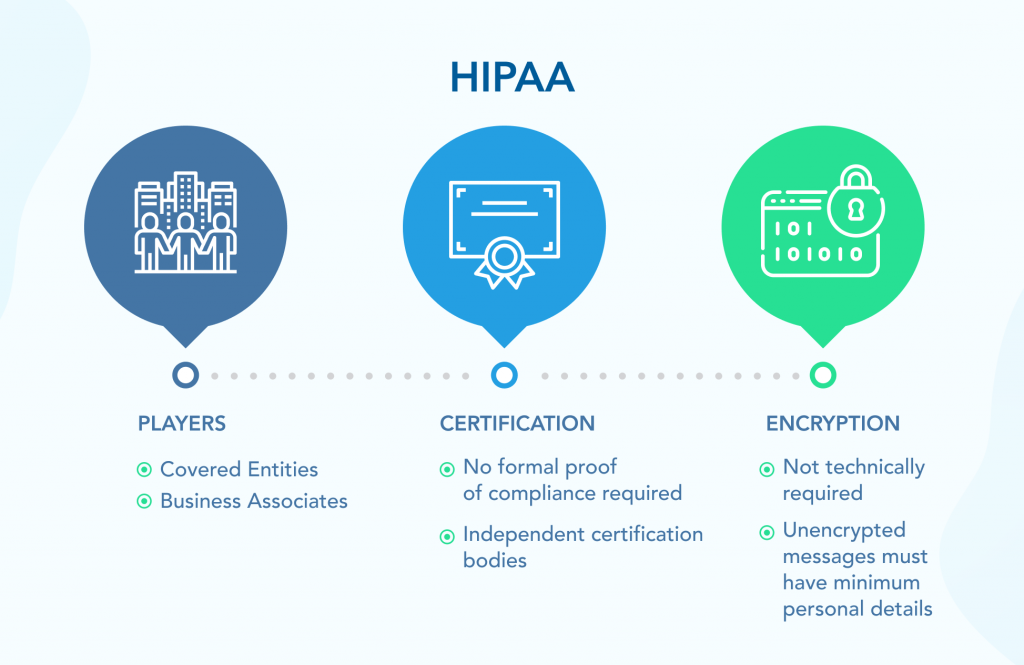
To begin with, various organizations are involved in performing patient treatment and providing supporting services like the procurement of medical equipment. HIPAA distinguishes between these major players, calling the first group Covered Entities or CE (e.g., a hospital) and Business Associates or BA (e.g., an accounting firm that provides services to a CE).
If you’re a CE who wants to collaborate with a BA, you must sign the so-called Business Associates Agreement or BAA. If you don’t, you’ll violate HIPAA and be severely penalized. This agreement is also obligatory if a BA subcontracts an external organization or decides to use an email service provider for secure email communications.
Therefore, when searching for a HIPAA-compliant email service, ensure that they are ready to conclude the BAA with you. Those who refuse to do so should raise suspicion. A typical BAA outlines all the HIPAA requirements concerning email encryption to keep protected healthcare information safe from illegal access.
It might seem a bit odd, but the law doesn’t require any written proof from healthcare organizations that they comply with the HIPAA guidelines. Thus, no HIPAA-compliant email service provider will show you a government-issued certificate of conformance.
Instead, there are a number of independent certification bodies that check email providers for meeting the HIPAA requirements. While not all of these deserve absolute trust, many do. Therefore, asking an email service provider if they have been certified for HIPAA compliance by a reputable company won’t hurt.
Another surprising thing about HIPAA is that it actually allows healthcare providers to send emails with the content as is without encrypting it. There’s a caveat, though. Only a limited amount of data and only specific details can be transmitted in this way. For example, HIPAA prohibits sending a message that contains information about the location where the recipient was born.
Therefore, to avoid the hassle of remembering the kind of data you can or can’t send over the wires, the end-to-end encryption of every message is the best approach to the doctor-doctor and doctor-patient protected healthcare information exchange. The more robust this email encryption is, the higher is the chance the exchange will be trouble-free from HIPAA’s viewpoint.
You should also know that HIPAA relieves CEs and BAs of any responsibility once an encrypted message has reached its destination in a secure manner. From then on, maintaining the email security rests with the person or entity “in point B.”
Thus, our tip: when considering HIPAA-compliant secure email services, find out about the kind of encryption they have in place.
With these essentials out of the way, let’s now take a look at three HIPAA-compliant secure email service providers you may give a shot.
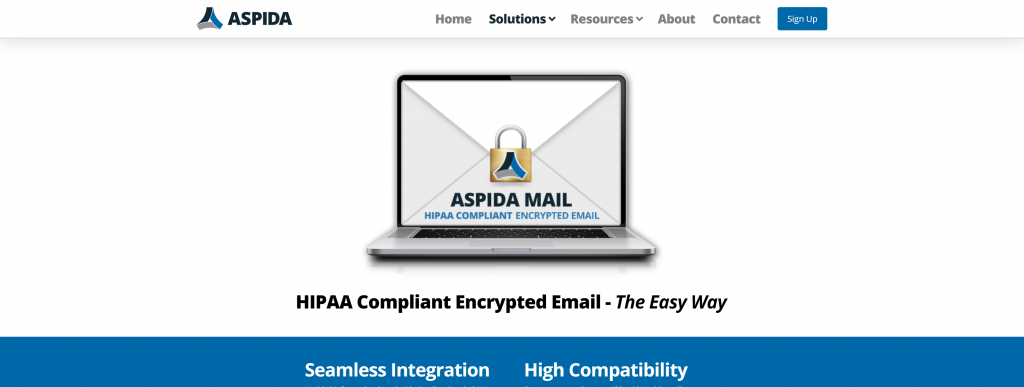
These guys take email security with all seriousness, meeting every HIPAA requirement for protected healthcare information transmission. If you’re used to email services like Gmail, though, you will find Aspida Mail a bit cumbersome to use since you need to go to a special portal and sign in before actually sending your mail. This, however, is a necessary step if you want your email to be truly HIPAA compliant.
Aspida Mail prides itself on its integration capabilities. If you’re accustomed to working with your mail via popular clients like Microsoft Outlook, you may continue doing so without any noticeable changes. The entire list of currently compatible programs includes 12 titles.
You have two options as far as pricing is concerned: Aspida Mail and Aspida Mail+. Both offer 30Gb of storage per mailbox. With the former plan, though, you can create addresses on the provider’s domain @aspidamail.net. The latter allows you to use addresses on your own domain.
Aspida Mail costs $10 a month for one mailbox. With Aspida Mail+, you pay $15 a month for one mailbox and $10 a month for every additional address.
All things considered, this is a great HIPAA-compliant email service provider with a bulletproof end-to-end encryption mechanism.
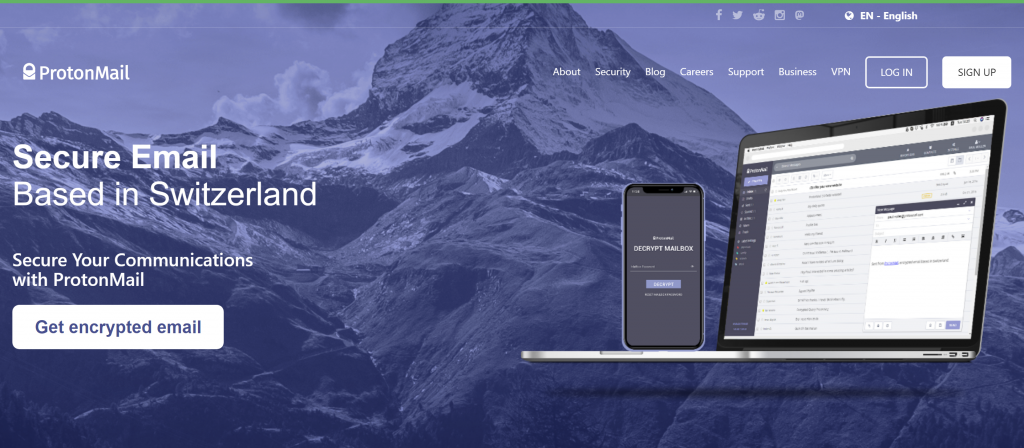
Not so long ago we did a review of the best email service providers based on specific criteria. Then, we described ProtonMail as one of the most secure solutions available on the market these days. The main reason for this is the well-qualified development team that consists of scientists from the Institute for Nuclear Research in Switzerland.
ProtonMail’s privacy policy allows you not to disclose your personal details for setting up an account. In addition, you can automatically destroy your messages by specifying a certain date in the future, and your IP address can’t be identified.
ProtonMail readily signs BAA. This clearly indicates that it’s a HIPAA-compliant email service provider. There are some drawbacks as well. For example, free-plan subscribers are only given 500 Mb of storage space. At the end of the day, though, ProtonMail is one of the top solutions for exchanging confidential medical details over the Internet.
Another HIPAA-compatible email solution worthy of every praise. It uses an advanced encryption mechanism (AES 256-bit) for all sensitive mail traveling back and forth along the wires. Just like Aspida Mail, NeoCertified provides integration with the major email programs, including Microsoft Outlook, Gmail, and Office 365.
It also caters to users of both Android and iOS-powered devices for secure messaging on the move. Among other features worth mentioning are the following:
Visit NeoCertified’s pricing plans page to learn about their fees.
Keeping in line with the HIPAA regulations is extremely important for every medical organization that deals with protected healthcare information. While the law doesn’t prohibit sending unencrypted messages, it sets strict rules as to their content.
That’s why finding a good HIPAA compliant email service provider to securely encrypt every message to patients or doctors is paramount. This will allow you to avoid data breaches and penalties. Why not start your search from the three solutions we’ve described in this post? Give them a try.
Whether you come from healthcare or another industry, advertising your organization or company doesn’t call for encrypting your promotional emails. They should be engaging, look professional, and render perfectly on any device or platform in the first place.
GetDevDone helps agencies and brands create responsive HTML email templates as part of our web design and HTML conversion services. Our team focuses on cross-client compatibility, reliable rendering, and thorough QA.
In addition, we meticulously check the validity of the templates on all supported email marketing platforms, such as CampaignMonitor.com, MailChimp.com, and iContact.com.

Responsive email templates with reliable rendering.
Order nowStart with the BAA, but do not stop there. A HIPAA-compliant email provider should fit your legal, technical, and daily workflow requirements.
Before choosing a provider, check:
The best option is usually not the provider with the longest feature list. It is the one your staff can use correctly without bypassing secure workflows under pressure.
No. A signed BAA is necessary in many HIPAA-related vendor relationships, but it does not make the whole email setup compliant by itself.
A BAA documents the provider’s obligations around PHI, permitted uses, safeguards, reporting, and subcontractors. The healthcare organization still has to configure the service correctly, manage access, train staff, define what can be sent, and document security decisions. The provider also has to actually operate according to the agreement and applicable HIPAA requirements.
This matters in real projects because compliance gaps often appear outside the contract: a shared mailbox with too many users, PHI copied into a non-secure CRM, patient data forwarded to a normal inbox, or screenshots with sensitive content added to a project ticket. A BAA reduces legal uncertainty, but it does not replace implementation discipline.
No, HIPAA does not currently state that every email containing PHI must always be encrypted in every situation. That does not mean normal email is safe for routine PHI exchange.
Under the HIPAA Security Rule, transmission security must protect ePHI sent over electronic networks. Encryption is treated as an addressable safeguard, which means the organization must assess whether it is reasonable and appropriate, implement it when it is, or document an equivalent alternative if it is not.
In practice, encrypting PHI-related email by default is usually the safer operational choice. Staff should not have to decide, message by message, whether a detail crosses the PHI line. Secure email also reduces the risk of accidental disclosure through forwarding, compromised accounts, or external mail systems outside the organization’s control.
Compare them by workflow fit, not only by the phrase “HIPAA-compliant email.”
Aspida Mail is a practical candidate when the team wants a dedicated secure email setup with compatibility for common mail clients and a secure portal workflow. It may suit teams that can accept an extra secure-login step for sensitive communication.
Proton Mail is stronger as a privacy-first option. It can make sense for teams that value end-to-end encryption, zero-access storage, and a separate secure email environment, but the organization still needs the right business plan, a signed BAA, and clear handling rules for messages sent to non-Proton recipients.
NeoCertified is usually the most natural fit when the team wants to keep working around Outlook, Gmail, or Microsoft 365 while adding secure email controls. For any of the three, test the real user journey before rollout: sender, recipient, mobile access, attachments, retention, and support requests.
For teams already built around Outlook, Gmail, or Microsoft 365, NeoCertified or Aspida Mail will often be easier to evaluate first because both are positioned around compatibility with existing email workflows.
NeoCertified is especially relevant when the organization wants secure email added around familiar tools rather than asking staff to move into a completely separate email environment. Aspida Mail can also work with common mail clients, but the exact fit depends on setup, mailbox structure, and how much portal-based workflow the team can tolerate.
Microsoft 365 and Google Workspace can also be part of a HIPAA-aligned environment if the right BAA, licensing, security configuration, admin controls, and user policies are in place. That is a different decision from buying a dedicated secure-email provider. For healthcare teams, the practical question is not “which tool is secure?” but “which setup will our staff actually use correctly every day?”
The mailbox price is only one part of the cost. Switching to a HIPAA-compliant email provider can also involve legal review, BAA handling, domain and DNS setup, mailbox migration, user provisioning, staff training, retention settings, template updates, and support documentation.
The larger hidden cost is workflow redesign. Teams have to decide which messages go through secure email, which belong in a patient portal, which notifications should avoid PHI, and who is allowed to access each mailbox. Existing forms, CRMs, automations, and marketing platforms may also need changes if they currently pass patient data into ordinary email.
For agencies supporting healthcare clients, this is where scope can quietly expand. A provider switch may look like a small IT task, but it can affect forms, autoresponders, transactional emails, data storage, QA, analytics, and post-launch support.
Not for PHI-related communication unless the platform, configuration, permissions, and legal basis support that use case. Regular marketing email platforms are usually fine for general promotional newsletters that do not include or reveal PHI, but that is different from patient-specific communication.
A newsletter about a new clinic location is not the same as an email that references an appointment, diagnosis, treatment, lab result, medication, insurance status, or patient segment that reveals health information. HIPAA marketing rules can also require authorization for uses or disclosures of PHI in marketing, with limited exceptions.
If the job is only to create campaign-ready layouts, GetDevDone can support teams with HTML email templates that render correctly across clients and ESPs. But decisions about PHI, consent, segmentation, platform use, and compliance review should stay with the healthcare organization’s legal, compliance, and security owners.
A compliant provider can still be connected to an unsafe workflow. The most common problems happen around the edges of the email system, not inside the provider’s marketing copy.
For example, a website contact form may send PHI to a normal inbox. An autoresponder may repeat sensitive form fields. A CRM integration may store patient details in a tool that is not covered by the right agreement. A staging environment may keep test submissions. A support person may forward a secure message into a project thread. DNS or authentication mistakes may break delivery and push staff toward manual workarounds.
For healthcare web development, the safer approach is to map PHI flow before implementation: forms, notifications, inboxes, portals, CRMs, backups, logs, analytics, and support access. Then test the workflow with dummy sensitive data before launch.
Find the right white-label web development company for your agency based on platform expertise, project scope, delivery model, and technical capabilities.

Compare Webflow vs WordPress to find the best CMS for your website based on flexibility, performance, scalability, and ease of use.

Compare Elementor and custom WordPress themes to find the most cost-effective solution for performance, flexibility, and growth.