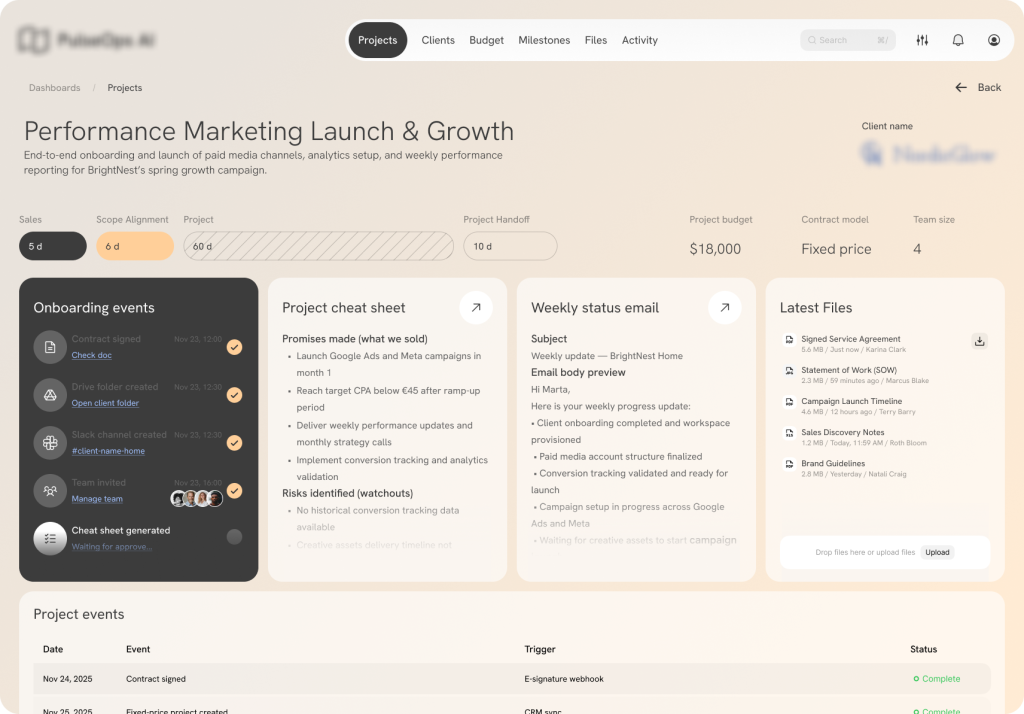
An event-driven workflow layer automatically creates project workspaces, schedules tasks, and drafts client communications based on project status. As a result, setup time drops to zero, and weekly client updates go out consistently with no extra manual effort.
A fast-growing marketing agency manages a diverse global client portfolio across industries. They provide ongoing SEO and content marketing services that consolidate scattered digital efforts into unified strategies, boosting engagement and conversions via SEO gains, targeted social reach, and efficient ad spend.
Business сhallenge
The agency was growing fast, but admin setup time didn’t scale. Each new client still took hours of manual work to provision workspaces and initialize projects. This led to two key issues:
Handoff friction: Sales details were buried in email threads, so delivery teams had to re-ask clients basic questions.
Inconsistent updates: Some clients got detailed weekly reports; others heard little, based on account manager bandwidth.
The client’s budget limits called for serverless architecture to avoid infrastructure costs. The system had to integrate with the existing tools without workflow havoc. Client-facing communications needed human review, as automated drafts could not be sent directly to clients. The solution also had to handle parsing across varied contract formats for reliable data extraction.
Solution delivered
Event-driven automation for onboarding and reporting To address these bottlenecks, GetDevDone’s team built an AI-driven serverless system that responds to state changes in the agency’s workflow. Instead of scheduled batch processes or manual checklists, the architecture automatically reacts to specific business events as they occur.
Trigger-based architecture The system monitors the agency’s operational data for qualifying events. When these moments are detected, they initiate automated sequences without requiring human intervention to start the process. This approach minimizes delays between business events and their required follow-up actions.
Dual automation strategy The solution targets two distinct operational bottlenecks. The first addresses new client setup: the gap between contract signature and delivery team readiness. The second addresses ongoing communication: the gap between project activity and client visibility. Both use the same underlying infrastructure but serve different stages of the client lifecycle.
LLM as a translation layer
Natural language processing bridges unstructured business documents and structured operational needs. Rather than training custom models, the system uses API-based LLM calls with prompts that extract meaning from contracts and sales notes, then reformat project data into client-appropriate summaries. Human review gates ensure accuracy before any external communication.
Key features & components
Automated workspace provisioning. When a contract is signed, the system immediately creates the client’s working environment: standardized folder structures in Google Drive, a dedicated Slack channel, and project management setup with the right team members invited based on what type of project it is.
Contract data extraction. PDF parsing pulls out the important details from signed agreements, including what was promised, when it starts, and who the key contacts are, and makes this information available to other parts of the system without manual data entry.
LLM-generated handoff documentation. The system reads through sales notes and contract text, then creates a one-page “Project Cheat Sheet” that lists what was sold, what risks to watch for, and important client context. This goes straight to the delivery team so they can start working with full visibility.
Human-gated client communication. Every Monday, the system drafts a weekly status email by pulling completed tasks and current blockers from the project management tool. Account managers get the draft in their inbox to review, edit if needed, and send, removing the compilation work while keeping human oversight.
Event-driven orchestration. Google Cloud Pub/Sub monitors for specific moments, like a contract getting signed, a task marked done, Monday morning arriving, and then kicks off the right automated actions in response, so nothing waits for manual initiation.
Serverless architecture. Google Cloud Functions run all the backend logic without dedicated servers or infrastructure management, keeping costs tied to actual usage and automatically scaling when workload increases.
Technologies & tools
TypeScript / Node.js, Google Cloud Functions: serverless backend orchestration
Google Firestore: database for state tracking and data persistence
Google Cloud Pub/Sub: event triggers and task queues
OpenAI API, GPT-4o:LLM integration for contract summarization and status draft generation
PDF.js: document parsing and contract text extraction
Project resets killing your margins?
Turn client data into real-time AI-driven campaign insights.
GetDevDone built and deployed the system in 7 weeks. The solution removed manual work from client onboarding and made weekly communication predictable across all accounts.
Fully automated onboarding New client environment setup dropped from 2-3 hours of manual work to zero. Workspace provisioning, folder creation, and team access configuration happen automatically on contract signature.
Better delivery team context The auto-generated Project Cheat Sheet gives delivery teams instant visibility into client commitments and risks, minimizing handoff meetings and sync calls with sales.
Consistent client communication Weekly updates reached 100% consistency across all accounts. Every client received a status summary regardless of the account manager’s workload or availability.
More account manager capacity Account managers save about 2 hours weekly per client on status emails. Time once spent gathering updates and drafting reports now goes to client strategy and higher-value tasks.
Standardized setup Standardized workspace setup ended inconsistencies from different team members configuring things their own way.
Talk to a commerce advisor to define the right architecture, platforms, and growth model for your business.
Get guidance on configuration, scalability, and compliance — tailored to your market and goals.