For a delivery ops team managing high client request volume, a coordinated set of agents handles each discrete step. They classify requests, structure briefs, draft tickets, and prepare client-ready responses, all inside the existing ecosystem. Humans approve; agents then route and draft. As a result of thoughtful AI engineering, the administrative load dropped and client capacity scaled without growing the AM team.
Our client, a full-service digital agency, blends creative campaigns, media buying, and web development to scale brands, turning analytics and creative ideas into results through integrated strategies for B2B and eCommerce.
Business challenge
As the agency grew, their coordination work expanded faster than revenue. Account managers were spending about 40% of their work week manually moving information between tools: client emails were discussed in Slack, Slack threads were turned into Asana tasks, and task updates were rewritten into confirmation emails for clients. This “human router” pattern created some compounding pressures.
Operationally, every new client increased the coordination load proportionally, forcing the agency to add AM capacity only to keep work moving rather than to grow output.
On delivery speed, fragmented context meant turning a client request into a clear internal ticket took up to 4 hours on average, a delay that pushed back the actual work.
On margins, growth meant hiring more coordinators to reformat information rather than building leverage, eroding profitability at the moment it should have been improving.
The agency needed to automate the process without replacing their existing tools or introducing a heavy new platform – all within tight timelines. The solution had to connect smoothly with Slack, Gmail, and Asana, keep Slack as the primary working interface, with no new front-end added. Also, every outbound message required human approval before sending, with no direct AI-to-client communication.
Solution delivered
To remove manual routing without replacing existing tools, the GetDevDone team implemented a stateful multi-agent system instead of a single automation script. The architecture is built around a Supervisor agentthat coordinates a set of specialized agents, each with a clearly defined responsibility. The Supervisor keeps the account context and decides how incoming requests should be handled.
The system follows a simple operating principle: “Review, don’t write.” The AI prepares drafts and structured outputs. Humans review and approve them before anything moves forward.
How the system works. Key components
The Supervisor agent acts as a traffic controller. It monitors designated Slack channels and email inboxes, classifies incoming messages, and keeps a dynamic profile for each account, including active campaigns, tone guidelines, and recent decisions. Based on the request, it routes the work to the appropriate specialist agent. Once routed, the task is handled by one of several focused agents.
The Brief Parser takes unstructured client input, whether a long email or a quick Slack message, and converts it into a standardized JSON brief. The brief clearly defines deliverables, deadlines, and required assets. This agent achieved an approximately 80% first-pass acceptance rate, meaning most drafts required little or no manual correction.
The structured brief is then passed to the Task Planner, which connects to Asana. It checks availability and drafts tickets with clear acceptance criteria derived directly from the brief, ensuring consistency between what the client asked for and what the team executes.
At the same time, the Comms Drafter prepares a confirmation message summarizing what was understood and when it is scheduled. This draft is presented to the Account Manager for review before sending.
Before any output reaches a human reviewer, the QA Checker validates it against internal “Do Not Do” constraints to reduce compliance or delivery risks.
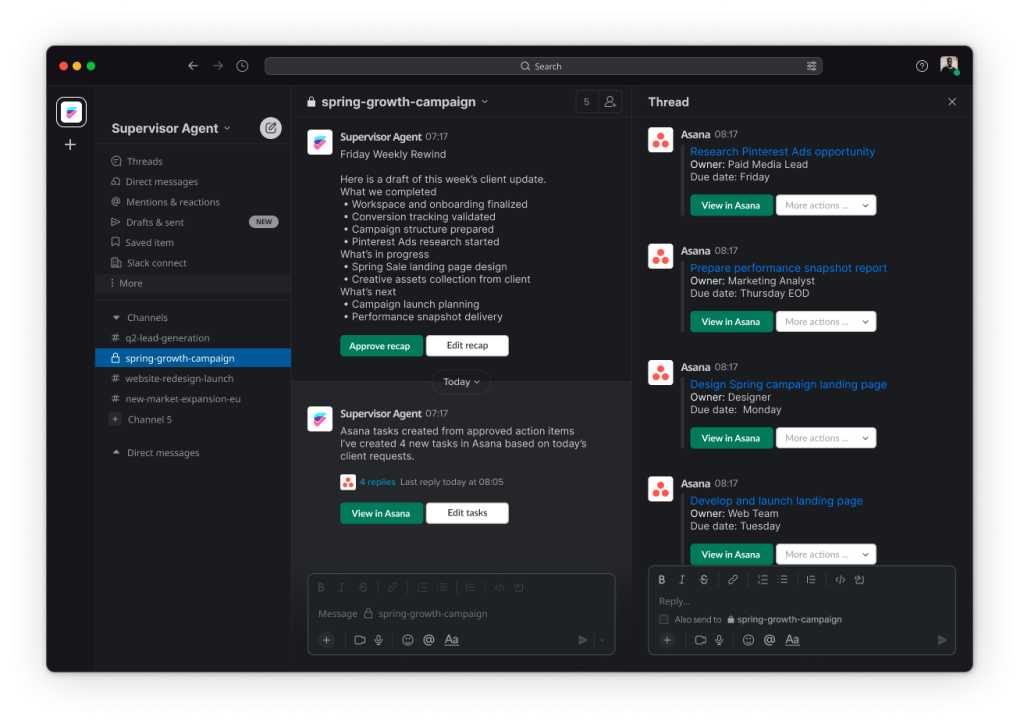
Every Friday, the Weekly Rewind agent scans completed tickets and key Slack decisions and generates a concise “What Changed” summary. Account Managers can review and send this as a client update without manually compiling the week’s activity.
Human-in-the-loop control
Slack approval buttons (“Approve” or “Edit”) enforce a mandatory review step, so no outbound message is sent automatically. The system operates with the expectation of high AI accuracy, but accountability remains fully human and nothing reaches the client without explicit approval.
Integration approach
n8n handles webhook connections, authentication, and workflow triggers across Slack and Gmail. This allowed the development team to focus on agent logic and orchestration rather than low-level API integration work.
The project took 8 weeks of development. At the end of the way, the system went live across five pilot accounts. Slack remained the working environment, and the system fit into existing habits, so adoption was fast and smooth. Manual routing and rewriting were replaced with structured drafts and clear review steps. Account managers stayed in control of client communication; the repetitive prep work around it got automated. Their time shifted from formatting and internal syncing to strategy and client relationships.
Recovered AM capacity
Account managers save about 12 hours per week ( 1.5 working days) previously spent routing information between email, Slack, and Asana. That time now goes toward client strategy, upsells, and proactive account work.
Faster execution start
Time from client message to a clearly defined internal ticket dropped from 4 hours to under 10 minutes. Delivery teams start work almost immediately instead of waiting for manual translation and structuring.
Operational leverage
The agency grew client load by 20% without adding administrative staff. LLM usage runs at approximately $0.40 per account per day – a fraction of the equivalent AM coordination time. Growing revenue no longer means hiring more coordinators, which keeps margins healthy as the agency scales.
More consistent handoffs
Around 80% of agent-generated briefs pass first review, so most need only light edits. Structured ticket formats mean fewer clarification cycles and cleaner execution, with a human still in the loop throughout.
Explore how we transformed BizDeva's vision into a stunning, functional WordPress website that captures the client's brand identity while enhancing user engagement.
Talk to a commerce advisor to define the right architecture, platforms, and growth model for your business.
Get guidance on configuration, scalability, and compliance — tailored to your market and goals.