A digital agency inherited an AI-generated marketing website that their client believed was ready to go live. A technical audit said otherwise. Three and a half weeks later, after a rebuild with the visual design fully preserved, it launched: stable, performant, and secure.
Our client is a full-service digital agency that offers precision-engineered marketing solutions for clients across multiple channels and markets.
Business challenge
An agency received a Lovable-generated marketing website from their end client, who expected it to go live immediately. Before launch, the agency ran an internal review, flagged concerns, and brought in GetDevDone’s AI engineering team for a full technical assessment. The audit confirmed that the site was visually complete and production-broken.
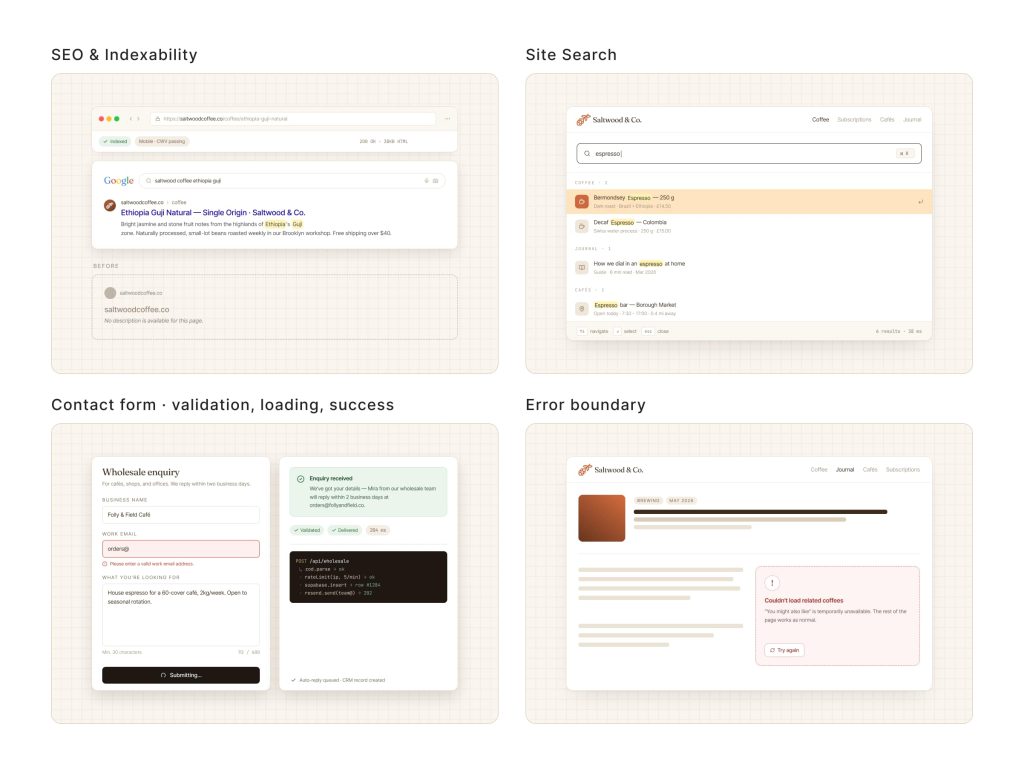
Invisible to search engines. Every page rendered client-side only, which meant no indexing; the site would have launched invisible to Google.
Authentication with no enforcement. Access control ran in the browser via localStorage tokens. The server never validated sessions, so anyone with basic technical skills could bypass it.
Forms that went nowhere. Full UI, like fields, buttons, and confirmation states, missed the backend. Every submission was silently lost.
Zero fault tolerance. The error boundaries were also missing. One failed API call could crash the entire site to a white screen for every visitor.
Unsafe path to deploy. The AI build lacked a staging environment and CI/CD pipeline. Every release was a manual push directly to production with no rollback structure.
None of these are edge cases. They’re the typical output of Lovable-generated code today: functional enough to demo, but not ready for production. The harder challenge wasn’t the code, but the client’s belief that the site was done, which meant resetting expectations and agreeing on scope had to come before any technical work could start.
Solution delivered
GetDevDone’s engineering team followed the established process: audit first, document everything, get scope agreement, then fix. No code was touched until the agency and their client had a written report in front of them.
Technical audit and written report. All codebase issues were documented and prioritized as launch blockers, pre-launch fixes, or items safe to defer. That report became the scope agreement, giving the agency and its client a shared answer to the only question that mattered at that stage: what’s broken, how the fixing would work, and in what order.
Server-side rendering migration. The site was rebuilt from a client-side-only framework to Next.js with server-side rendering — the change that made pages indexable by search engines. Page load performance improved as a direct result: Lovable bundles the entire app into one JavaScript file; Next.js loads only what each page needs.
Authentication rewrite. Session management moved from the browser to the server via NextAuth. Now the server decides whether a user was logged in on every request – the critical security bar for any site with user accounts.
Form back-end connection. Every form was wired to a server-side handler with input validation, rate limiting, and email delivery.
Error handling. Error boundaries were added at the page and component levels. Failures now surface as contained error states instead of taking down the entire site.
CI/CD pipeline and staging environment. A GitHub Actions pipeline automated builds and deployments to Vercel, with a staging environment added before production.
The visual design was untouched throughout. Every change lived underneath, invisible to visitors, essential to everything else.
The site launched 3.5 weeks after the initial audit, on scope, without any surprises or rework cycles.
Live and findable from day one
Every page is now server-rendered and indexable by search engines. For a marketing website, organic search is often the primary acquisition channel.
Performance that holds up on every device
Route-based loading and optimized assets replaced a single oversized bundle. Core Web Vitals now pass on both mobile and desktop.
Every lead captured
The contact form submissions now reach the inbox through a validated back-end with email delivery.
A clean handoff the agency can stand behind
The audit report gave both the agency and its end client a shared written record of findings, remediations, and reasons, turning a delivery into an accountable handoff.
Security that holds
Authentication is now enforced server-side on every request. User sessions are validated so that they can’t be tampered with.
GetDevDone built an AI-powered knowledge assistant that turns the agency's internal document library into a searchable source of truth for the account team.
AI-generated code broke a Stripe and Memberstack integration in the payment system. See how GetDevDone diagnosed, reconciled, and fully restored the system.
Talk to a commerce advisor to define the right architecture, platforms, and growth model for your business.
Get guidance on configuration, scalability, and compliance — tailored to your market and goals.