After a client’s AI-generated code broke a working payment system for ~1 month, GetDevDone diagnosed the failure, reconciled, and rebuilt the payment architecture with the intended UI update, restoring revenue, subscriber access, and system integrity
NIKLY Media Ltd. is a specialized web development firm delivering custom digital solutions to empower businesses of all sizes. They focus on responsive, brand-aligned websites using platforms like WordPress, HubSpot, and Shopify to drive growth and user engagement.
Business сhallenge
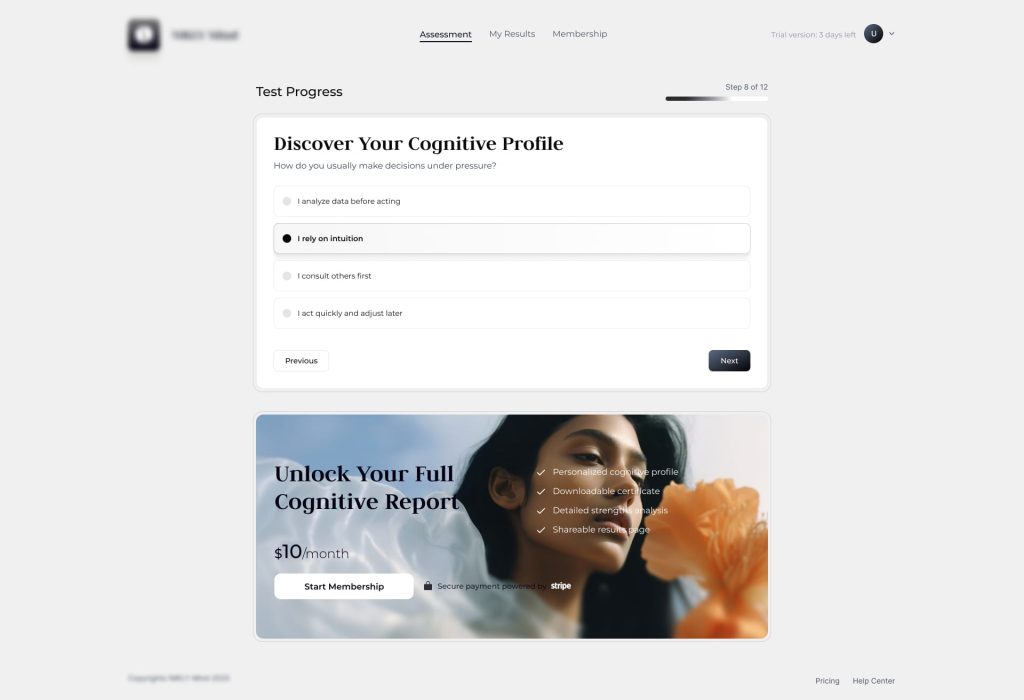
The client had a fully functional platform: a blog, responsive design, and a subscription system where users could take a cognitive assessment, receive their results, share them on social media, and download a personalized certificate. Stripe handled billing, Memberstack controlled content access, and a custom backend layer connected the two.
They needed one change: separate buttons per subscription plan instead of a single checkout flow.
To avoid engaging the AI engineering team, they used an AI code generation tool — a pattern now known as “vibe coding”, and deployed the output directly to production, skipping sandbox testing and validation against the existing integration.
The code worked in isolation, but had no awareness of how the payment flow was wired into the rest of the system. Instead of extending the existing integration, it replaced parts of it, breaking the connection between Stripe’s billing logic and Memberstack’s access control and pushing both systems out of sync.
The subscription system stopped working for approximately one month:
New subscriptions failed. The page appeared to accept payment, but no transaction completed on the backend.
Existing subscribers lost access. Active subscribers were locked out of content they had already paid for.
Billing records mismatched. Transactions existed in Stripe but not in Memberstack, and vice versa, with real customer data across two live systems that couldn’t be reset.
We aimed to repair the architecture and add the feature properly after restoring system integrity.
Solution delivered
GetDevDone structured the recovery in four phases, each designed to avoid introducing new risk into a system that had already failed in multiple interconnected ways.
Diagnostic audit. The team ran a full diff between the deployed code and the original build to identify exactly what the AI-generated code had changed, added, and removed. The audit highlighted new functions, event handlers, and API calls that conflicted with the existing webhook and session architecture — far more code than the change needed, with no awareness of the dependencies it was breaking.
Controlled rollback. The AI-generated payment logic was removed entirely, and the original integration was restored as a clean baseline. Patching over a compromised integration carries the same risk of silent failures that caused the outage, so the team rebuilt from a known-good state.
Then, they implemented the intended UI change — separate buttons per subscription tier within the reengineered architecture, keeping webhook handling, session creation, and Memberstack access control flows.
Cross-system reconciliation. With the code back in place, the team went through Stripe and Memberstack, record by record, matching subscription states and correcting every inconsistent entry from the downtime period. This required direct API-level work across both systems to fix subscriber access without disturbing legitimate billing data.
Testing and hardening. Before redeployment, the full payment lifecycle was tested in Stripe’s test mode, covering new subscriptions, renewals, cancellations, failed payments, and card updates. The restored system went live with payment event logging in place, so if anything breaks in the future, it shows up immediately instead of failing silently.
Technologies & tools
Webflow & Astro: frontend and site layer
Stripe: billing, subscription management, and webhook lifecycle
The recovery took 4 weeks, brought the platform back to full functionality, and left the system in a stronger state than before the incident.
Revenue back online
Subscriptions resumed processing and existing subscribers regained access, ending about a month of lost revenue and user lockout.
Data integrity secured
Every subscriber’s billing status and access state were brought into full consistency across Stripe and Memberstack, with no legitimate customer records altered.
Feature delivered
The original UI change: separate buttons per subscription tier was correctly implemented within the rebuilt architecture.
Observability improved
Payment event logging now surfaces anomalies in real time, replacing the silent failure mode that made the incident difficult to detect in the first place.
Full lifecycle validated
Five payment scenarios: new subscription, renewal, cancellation, failed payment, and card update were tested end-to-end before the system went back to production.
AI is a tool our engineers use every day – it makes us faster. But it’s not a replacement for engineering. This case is a good example: a client had a working payment system, used AI to make what seemed like a small change, and ended up with a month of downtime and broken subscriptions. The change itself wasn’t hard – we could have done it in a day or two. The cost of the AI shortcut was orders of magnitude higher than the cost of doing it properly.
The cost of the shortcut
The full recovery ran $2,000–$6,000 over 1–4 weeks. The original UI change, properly scoped from the start, would have cost a fraction of that with zero downtime.
The broader insight. AI tools can speed up well-defined tasks, but they have no awareness of how a live system’s components depend on each other. In this case, the generated code worked in isolation but replaced critical parts of an integration it couldn’t see, triggering failures across billing, access control, and session logic. Fixing it took engineers who understood the full architecture, knew where the edges were, and could make judgment calls that a tool simply can’t. That’s what made recovery possible.
GetDevDone built an AI-powered knowledge assistant that turns the agency's internal document library into a searchable source of truth for the account team.
A scalable hub for portfolio-wide analytics helps clients structure marketing information for reporting. It connects Adverity, BigQuery, and Looker Studio using reusable templates to standardize inputs across sources. This supports churn and propensity modeling across their portfolio and creates consistent dashboards. A client reduces manual preparation time and can track churn and risk across all accounts.
Compare the best headless CMS for React: Storyblok, Sanity, Hygraph, Strapi, Contentful, Prismic, and more with features, use cases, and selection criteria.
Best headless eCommerce platforms compared: commerce tools, Shopify Plus, and BigCommerce on API-first architecture, composable CMS, pricing, and rollout steps
Talk to a commerce advisor to define the right architecture, platforms, and growth model for your business.
Get guidance on configuration, scalability, and compliance — tailored to your market and goals.