

Rescuing a Lovable AI build before it launched broken
AI-generated site audit & rebuild: fixed SSR, auth, forms, and CI/CD. Stable, secure, Google-indexable.
GetDevDone Team
- 3 min read

TL;DR
Best AI code cleanup partner clearly advises on fix vs. refactor vs. partial rebuild vs. full rebuild of AI-generated website. Fastest remediation starts with a technical audit, then a clear recovery path, then development.
AI code cleanup companies help agencies recover AI-generated websites that become risky to launch, hand off, or maintain. Their role is to assess the codebase, identify what can be salvaged, and determine whether the project needs remediation, production hardening, a partial rebuild, or a full rebuild. For agencies, the goal is to deliver a stable website without introducing new delivery risks.
When evaluating providers, website development capability matters more than AI credentials. Most production issues involve CMS workflows, payment systems, forms, authentication, integrations, deployment pipelines, security gaps, and performance problems that only appear after real-world testing. Agencies need partners that can diagnose and resolve them.
GetDevDone is a strong fit for agencies rescuing AI-generated builds, CMS implementations, front-end projects, and eCommerce builds before launch or handoff. Other vendors on this list may be a better fit for enterprise software recovery, platform-specific rebuilds, Shopify remediation, AI code stabilization, or specialized QA-focused engagements.
| Company | Best for | Core strengths | Better fit when | Not ideal when |
| GetDevDone | Agencies rescuing AI-generated client websites before launch or handoff | Agency-facing delivery support across CMS, front-end, eCommerce, QA, deployment, and documentation recovery | The agency inherited a broken website and needs to get it launched, handed off, or maintained without restarting the project | The project is still an early-stage prototype and does not yet require production-ready delivery |
| Kitrum | Mid-market SaaS and startup teams inheriting AI-generated code | AI code audits, architecture assessment, stabilization planning, and engineering handoff | The team inherited AI-generated code and needs an independent assessment before committing to a fix or rebuild | The priority is rescuing a client-facing website or an eCommerce project under delivery deadlines |
| AssurePath | Teams struggling to stabilize projects built with Bolt, Replit, Claude Code, or similar tools | AI-builder rescue, engineering oversight, scoped remediation, and practical recovery planning | The project was built quickly with AI tools and now needs experienced engineers to make it viable | The project involves complex CMS architectures, enterprise systems, or large storefront implementations |
| Bluedge | Shopify agencies and merchants dealing with AI-generated Shopify issues | Shopify-only remediation, Liquid troubleshooting, checkout recovery, and app integration fixes | The business is committed to Shopify, and the problems are isolated to the Shopify ecosystem | The project requires a broader CMS, front-end, or multi-platform website rescue |
| Afterbuild Labs | Lovable and Bolt projects that need to move beyond the prototype stage | Fixed-scope AI-builder rescue, cleanup, and production hardening | The prototype demonstrates value, but the codebase is not ready for ongoing development | The project requires agency delivery support, CMS recovery, eCommerce remediation, or client handoff workflows |
| Nuvanta AI | Enterprise teams turning AI-built applications into production systems | Authentication, security hardening, testing, monitoring, CI/CD, architecture cleanup, and operational readiness | The application works, but security, reliability, and deployment processes are preventing production use | The project is a typical marketing website, CMS implementation, or agency website delivery engagement |
Not all AI code cleanup projects look the same. A Shopify store with a broken checkout is a different problem than a CMS implementation nobody can maintain or an AI-generated codebase that needs a complete rebuild. That’s why we included in this list companies that solve different types of recovery problems.
To make the shortlist, companies needed publicly visible evidence of rescue, remediation, stabilization, or rebuild work. We also looked for experience with the systems that tend to create launch and handoff problems: CMS platforms, eCommerce functionality, authentication, payments, integrations, QA, security, and deployment.
Agency fit mattered too. Many cleanup and rescue projects happen in the middle of an active client engagement, where timelines, handoffs, and delivery commitments already exist. Public information from service pages, case studies, portfolios, reviews, and client examples was used throughout the evaluation.
Start with the audit, but pay attention to what the audit is designed to answer. A useful audit answers a business question: Is this website worth fixing, or will a rebuild cost less than continued remediation?
We, at GetDevDone, advise evaluating how the vendor talks about recovery options. Some companies profit when every project becomes a rebuild. Others try to save code that should be replaced. The valuable part is the reasoning behind the recommendation and whether it aligns with the actual condition of the project.
Many agencies notice the signs that an AI-generated website build needs rescue only after the website appears ready for launch. At that stage, production experience matters more than AI experience.
The question is whether the team can support the systems behind the website: CMS workflows, eCommerce functionality, payments, authentication, APIs, integrations, QA, security, performance, and deployment. Experience with AI coding tools is useful. Experience with production systems is what determines whether the project can be launched, handed off, and maintained.
Finally, ask what happens if the initial recommendation turns out to be wrong. Strong rescue partners have a path for that scenario. Weak ones discover it only after the budget and timeline have already been approved.
| Buyer need | Best vendor type | What to check before hiring |
| You inherited an AI-generated website and do not know whether it should be fixed or rebuilt | Audit and assessment specialist | Whether the audit is designed to answer fix vs rebuild questions |
| The website works but contains unstable code, technical debt, or maintainability problems | Remediation and refactoring partner | Experience working with existing codebases |
| The website is functional but not ready for launch | Production hardening team | QA, security, performance, deployment, authentication, forms, and integration experience |
| AI-generated code created recurring bugs across multiple systems | Partial rebuild partner | Ability to preserve the working parts of the project while replacing unstable components |
| The architecture is unstable and future development is becoming difficult | Full rebuild partner | Experience migrating existing projects without disrupting business operations |
| The project includes checkout, payments, customer accounts, and complex integrations | eCommerce rescue specialist | Platform expertise, payment integrations, authentication, and third-party system experience |
| The agency needs to deliver the project to a client | Agency-focused rescue partner | Handoff support, documentation, fixed-scope delivery, and behind-the-scenes collaboration experience |
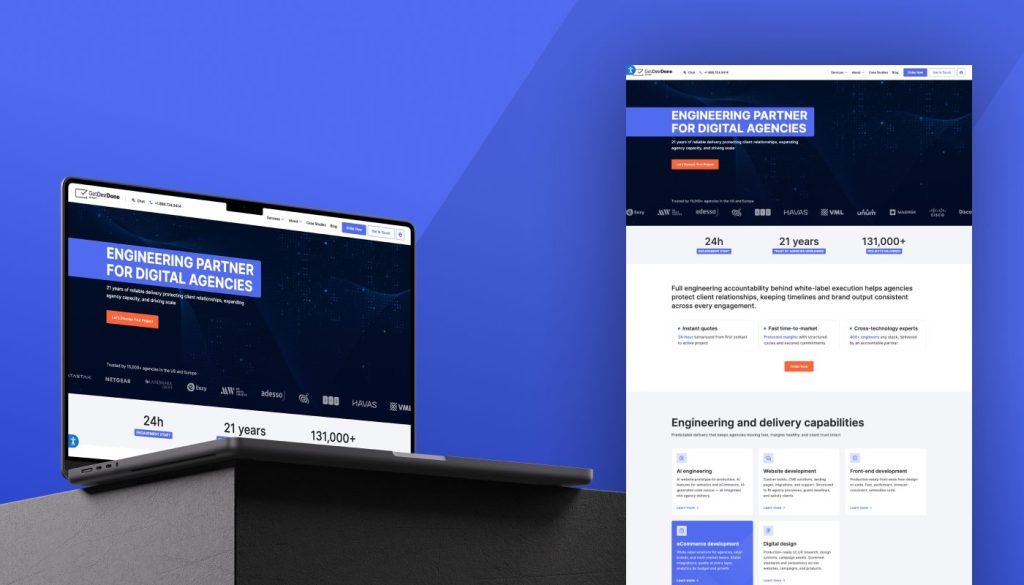
Best for:
Agencies rescuing AI-generated client websites, CMS builds, front-end implementations, and eCommerce projects before launch or handoff.
Why it is included:
GetDevDone offers AI build rescue and rebuild services for agencies and brands, focused on recovering AI-generated builds that are not ready for production despite appearing complete. Its public rescue methodology centers on evaluating the most practical recovery path, whether that means remediation, refactoring, partial rebuilding, or a full rebuild.
Relevant services:
Evidence:
Published case studies include a Lovable-generated marketing site rebuilt on Next.js after a pre-launch audit found broken auth, disconnected forms, and no deployment pipeline — launched 3.5 weeks after audit. A second case covers recovery of a live Stripe and Memberstack integration broken by AI-generated code changes, including API-level billing reconciliation across both systems.
Strengths:
Limitations:
Not the best fit for small standalone bug fixes or teams looking for a self-service AI coding platform. Some projects may still require a full rebuild rather than remediation.
Best-fit project type:
AI-generated client websites and web applications that need technical review, stabilization, or recovery before launch or handoff.
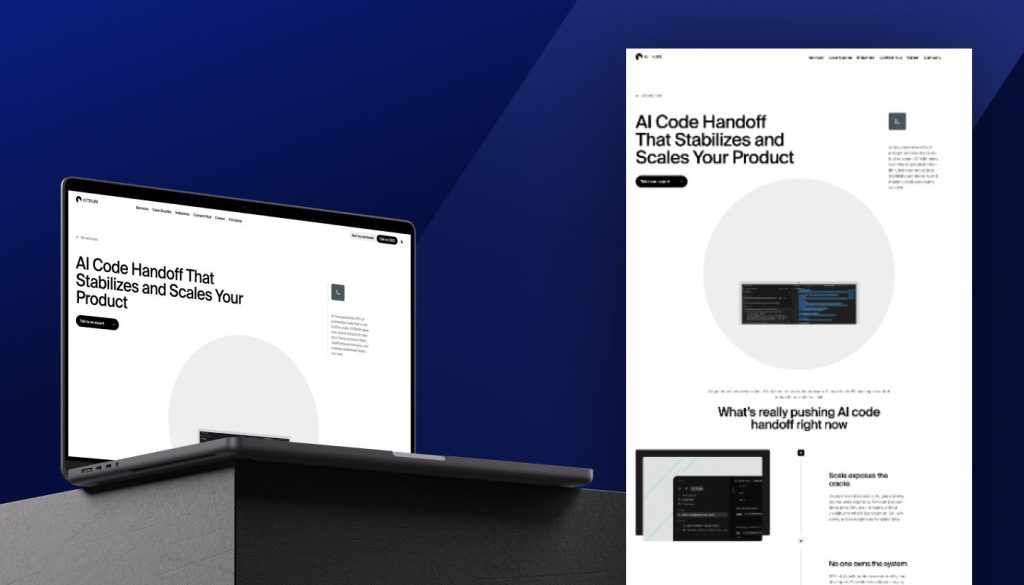
Best for:
Mid-market SaaS companies and startup teams, inheriting AI-generated code before scaling, fundraising, compliance reviews, or technical due diligence.
Why it is included:
Many AI-generated products reach a point where nobody on the team fully understands how the system works. Kitrum’s AI Code Handoff & Stabilization practice is built around that transition, helping companies regain architectural visibility, establish engineering ownership, and reduce the operational risks created by rapidly generated code.
Relevant services:
Evidence:
Kitrum maintains a dedicated AI Code Handoff & Stabilization service focused on assessing, documenting, and stabilizing AI-generated systems. Public materials place particular emphasis on technical due diligence, compliance readiness, ownership transfer, and production scalability for companies moving beyond the initial build stage.
Strengths:
Limitations:
Less focused on agency website recovery, CMS remediation, or eCommerce launch support. Public examples are weighted toward software products and SaaS platforms rather than client-facing marketing websites.
Best-fit project type:
AI-generated SaaS products and internal business platforms that require architecture review, stabilization, documentation, and operational ownership before scaling.
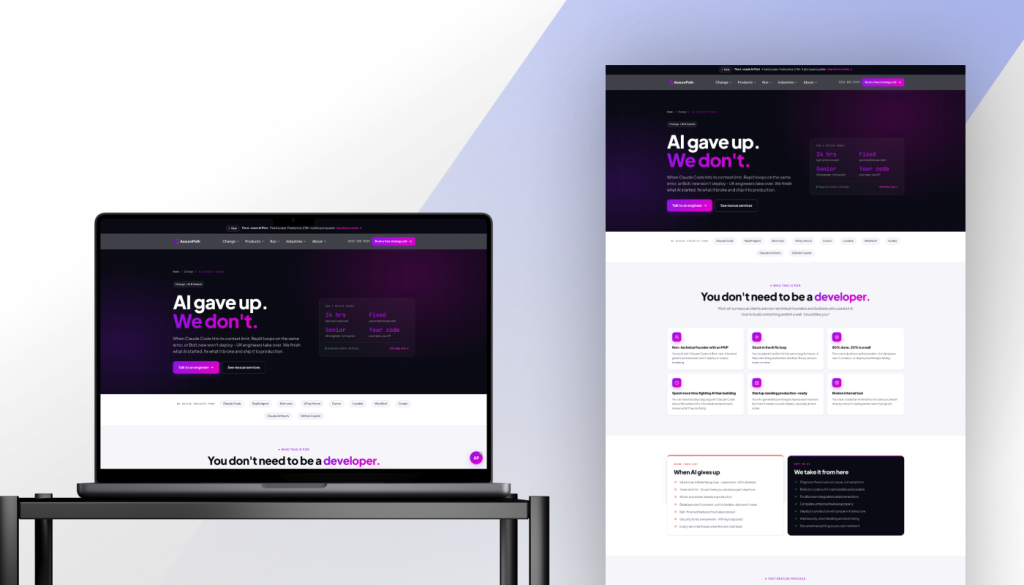
Best for:
Non-technical founders and small teams struggling to finish AI-generated projects built with Claude Code, Replit, Bolt.new, Lovable, Cursor, or similar tools.
Why it is included:
AssurePath is built around helping non-technical users who hit the limits of AI coding tools. The service is designed for founders who have a working prototype or partially completed product but lack the engineering expertise needed to diagnose deployment, integration, security, or reliability issues.
Relevant services:
Evidence:
AssurePath operates a dedicated AI Project Rescue service focused on projects built with Claude Code, Replit, Bolt.new, Lovable, Cursor, and other AI coding tools. Public materials include documented rescue workflows, fixed-quote assessments, and client testimonials describing recovery of broken authentication, deployment failures, database connectivity issues, and unstable internal tools.
Strengths:
Limitations:
May be less suitable for organizations that already have established engineering teams and need large-scale architecture, governance, or modernization initiatives. The service is primarily geared toward helping founders and small teams get stalled projects moving again.
Best-fit project type:
AI-generated MVPs, internal tools, and startup products that are mostly built but blocked by deployment, integration, authentication, database, or stability issues.
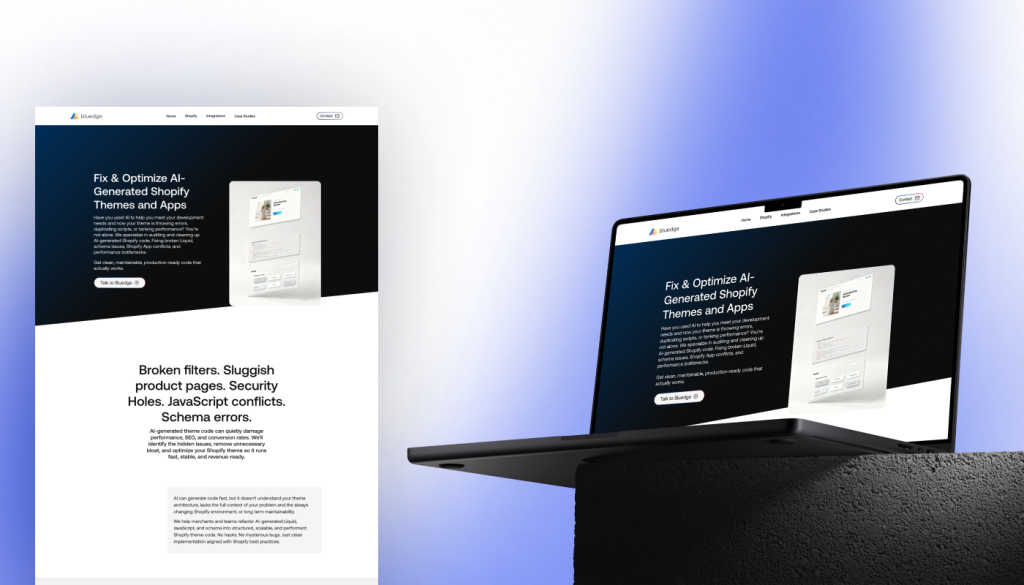
Best for:
Shopify merchants and agencies dealing with AI-generated Shopify theme, app, checkout, or performance issues.
Why it is included:
Bluedge focuses exclusively on Shopify. Its AI Code Fix service is built around problems that commonly appear when merchants use AI tools to modify Liquid templates, generate custom app functionality, or make theme changes without fully understanding Shopify’s architecture.
Relevant services:
Evidence:
Bluedge maintains a dedicated Shopify AI Code Fix service focused on cleaning up AI-generated Shopify code. Public materials specifically reference remediation of broken Liquid implementations, schema errors, app conflicts, duplicated scripts, checkout issues, security vulnerabilities, and performance bottlenecks. Public materials identify Bluedge as a Shopify-focused development partner with Shopify ecosystem expertise.
Strengths:
Limitations:
Best suited to Shopify-specific rescue scenarios. Projects involving broader CMS ecosystems, custom web applications, or multi-platform architectures may require a more generalist engineering partner.
Best-fit project type:
Shopify stores where AI-generated code has introduced theme instability, app conflicts, checkout problems, security concerns, or performance degradation.
Best for:
Founders and startup teams whose AI-generated apps are stuck between MVP and production.
Why it is included:
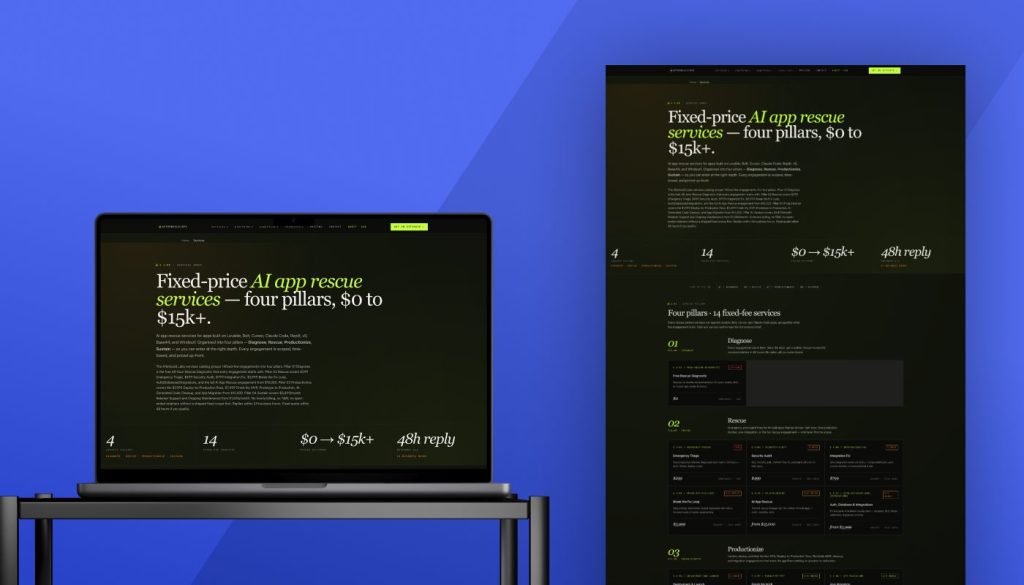
A recurring challenge with AI builder platforms is that a product appears finished but still lacks the systems needed for a reliable launch. Afterbuild Labs focuses on closing that gap through fixed-scope rescue, cleanup, deployment, and productionization services designed specifically for AI-generated applications.
Relevant services:
Evidence:
Afterbuild Labs offers a dedicated catalog of fixed-fee rescue services for apps built with Lovable, Bolt.new, Cursor, Claude Code, Replit, Base44, Windsurf, and v0. Public materials describe structured rescue workflows covering deployment failures, authentication issues, Stripe integrations, security risks, and prototype-to-production transitions. The company also publishes transparent pricing, rescue-versus-rewrite assessments, and platform-specific remediation services.
Strengths:
Limitations:
May be less suitable for projects that require agency delivery support, CMS recovery, eCommerce remediation, or client handoff workflows. The service is primarily geared toward founders and startup teams working with AI-generated applications.
Best-fit project type:
AI-generated MVPs and startup applications that demonstrate business value but require stabilization, cleanup, deployment, or production hardening before launch.
Best for:
Enterprise teams and growing startups, preparing AI-generated applications for production environments.
Why it is included:
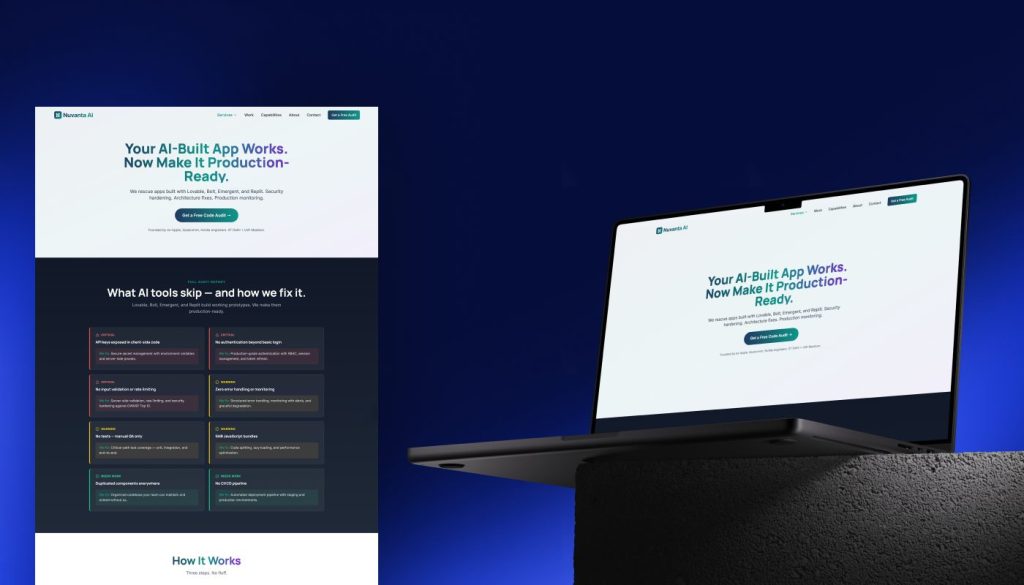
Getting an application to work is only part of the challenge. Nuvanta AI focuses on the engineering layers that AI-generated projects often miss, including security, authentication, testing, monitoring, deployment processes, and architectural reliability. Its positioning is centered on helping teams bridge the gap between a functioning application and a production-ready system.
Relevant services:
Evidence:
Nuvanta AI maintains a dedicated AI Code Rescue practice supported by a publicly documented production-readiness framework. Its published materials highlight recurring issues found in AI-generated codebases, including exposed API keys, weak authentication, missing input validation, inadequate monitoring, and deployment risks. The company also positions rescue work alongside enterprise AI systems and production software engineering services.
Strengths:
Limitations:
Not the strongest fit for marketing websites, CMS implementations, or agency-led website delivery projects. The company’s approach is better aligned with software products and internal business systems than traditional web development engagements.
Best-fit project type:
AI-generated applications that function at a prototype or MVP level but require security hardening, architectural cleanup, testing, monitoring, and deployment processes before production use.
GetDevDone is the strongest fit for agencies that inherit unstable client websites and need to get them launched, stabilized, documented, or handed off without restarting the project. Its public rescue work covers CMS implementations, front-end builds, eCommerce functionality, integrations, QA, and production readiness.
Bluedge becomes the more relevant option when the project is built on Shopify and the problems are limited to Liquid code, checkout flows, storefront performance, or Shopify app integrations.
For applications that already function but lack security controls, testing, monitoring, authentication, or deployment discipline, Nuvanta AI offers a more specialized production-readiness focus.
Kitrum is often a better match when stabilization efforts are tied to architecture ownership, compliance requirements, technical due diligence, or future scaling plans.
Where the cleanup effort is confined to Shopify themes, Liquid templates, storefront performance, or Shopify-specific integrations, Bluedge provides deep platform specialization.
GetDevDone is particularly well-suited to projects where AI-assisted development created maintainability issues, front-end instability, component inconsistencies, or CMS workflow problems.
GetDevDone is a strong option when payment workflows, authentication systems, forms, or third-party integrations are affecting website functionality, launch readiness, or client delivery.
In Shopify environments, Bluedge brings expertise in checkout customization, app integrations, storefront performance, and platform-specific troubleshooting.
Afterbuild Labs is more applicable to AI-generated applications that have already moved beyond the prototype stage but remain blocked by Stripe integrations, authentication issues, deployment failures, or production-readiness gaps.
For AI-generated MVPs, Afterbuild Labs focuses on rebuilding the specific systems that commonly prevent launch, including authentication layers, deployment infrastructure, payment integrations, and security controls.
GetDevDone is the best fit when a working website functionality has to be preserved while unstable templates, integrations, workflows, or architectural components are selectively replaced.
Kitrum becomes more relevant when the partial rebuild decision depends on architecture assessment, maintainability concerns, engineering ownership, or long-term scalability.
GetDevDone is a strong fit for rebuilding websites, CMS implementations, and eCommerce projects that still need to reach launch or handoff milestones. Their service is relevant for agencies inheriting AI-generated work that can no longer be safely maintained.
When the rebuild is motivated by architecture quality, technical due diligence, compliance requirements, or long-term ownership concerns, Kitrum offers a stronger alignment.
Afterbuild Labs specializes in helping teams move AI-generated applications from demo status to production readiness, particularly across platforms such as Lovable, Bolt.new, Replit, Cursor, and Claude Code.
AssurePath serves a similar audience but is often a better fit for non-technical founders and small teams that need practical engineering support to overcome deployment, integration, authentication, or stability issues.
Nuvanta AI is particularly focused on production readiness, security hardening, authentication, testing, monitoring, and deployment processes for AI-generated applications.
When architecture ownership, compliance readiness, engineering governance, or technical due diligence are also part of the challenge, Kitrum provides a broader stabilization and long-term maintainability perspective.
An AI build rescue company helps recover AI-generated websites and applications that are difficult to launch, maintain, or hand off. Its role is to assess the existing codebase, identify what can be salvaged, and determine whether the project requires remediation, production hardening, a partial rebuild, or a full rebuild.
AI code remediation typically focuses on fixing specific technical issues within an existing codebase. AI build rescue takes a broader view, evaluating architecture, integrations, deployment, security, maintainability, and launch readiness alongside the code itself. AI code remediation services may be one part of a rescue engagement, but they are not always enough to make a website production-ready.
A rescue approach is usually worth considering when the website contains working functionality that can be safely retained. Stable components can often be preserved while fixing issues with integrations, authentication, payments, forms, templates, or deployment infrastructure. If the underlying architecture is fundamentally unreliable, a partial or full rebuild may be the lower-risk option.
Look for visible experience with production systems rather than AI tools alone. A qualified vendor should be able to explain how they evaluate remediation versus rebuilding, identify risks across CMS workflows, integrations, authentication, payments, QA, security, and deployment, and provide examples of previous vibe code cleanup or recovery work. The assessment process is often more important than the repair itself.
A useful audit should evaluate architecture, maintainability, security, performance, deployment readiness, integrations, authentication, forms, payment systems, error handling, and documentation quality. The most valuable audits also answer a business question: whether the project should be remediated, partially rebuilt, or rebuilt entirely.
The fastest way to reduce risk is to assess the project before additional development begins. Agencies should determine whether the codebase is salvageable, identify production blockers, document critical dependencies, and create a clear recovery plan. Delaying that assessment often increases technical debt, expands the scope of future remediation work, and creates additional launch risk.
This is not an independent research report, analyst ranking, sponsored placement, or paid directory listing. The companies included in this article were identified and evaluated using publicly available information available at the time of publication, including company websites, service pages, case studies, portfolios, and verifiable third-party review platforms, combined with AI-assisted research and human editorial review conducted by the GetDevDone team. The selection and ordering of companies reflect our editorial judgment regarding their visible relevance to agencies and white-label delivery based on the criteria discussed in this article. Different agencies, project requirements, budgets, and operating models may reasonably lead to different conclusions. We have made a good-faith effort to evaluate companies based on verifiable public information rather than marketing claims alone. However, this list is not exhaustive, definitive, or free from editorial perspective.
AI-generated site audit & rebuild: fixed SSR, auth, forms, and CI/CD. Stable, secure, Google-indexable.
AI-generated code broke a Stripe and Memberstack integration in the payment system. See how GetDevDone diagnosed, reconciled, and fully restored the system.
Discover 7 tested signs your AI‑generated website build needs rescue before launch, and GetDevDone advice when it’s better to rebuild than keep patching
Turn AI prototypes into production-ready systems without delays or margin loss risks. Built for agencies under delivery pressure.


