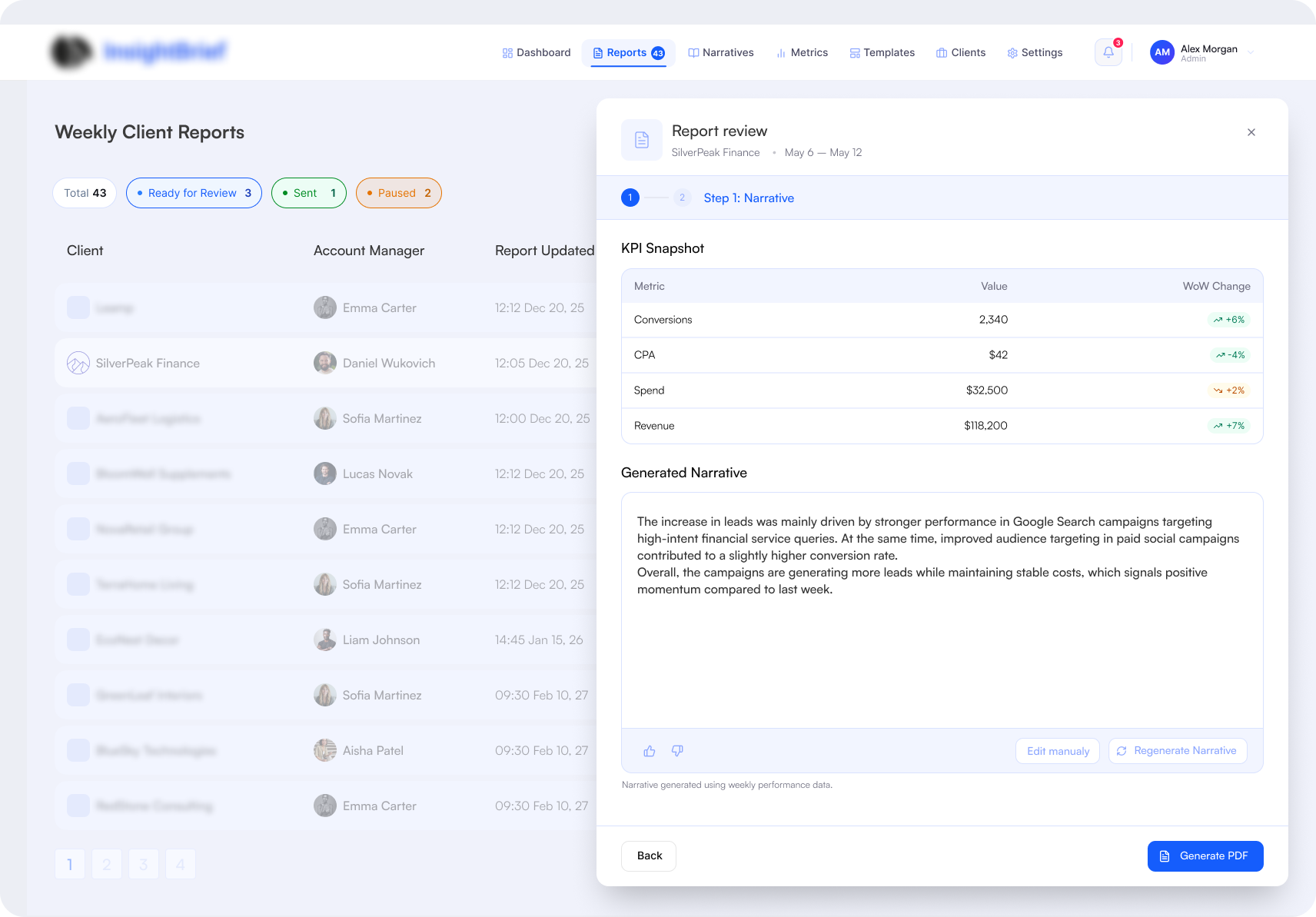
A performance marketing agency replaced manual write-ups with an automated AI-supported reporting system that turns campaign data into consistent, client-ready summaries, while keeping human review before sending.
A 40-person strong performance marketing agency managing a focused roster of mid-market clients across paid search, paid social, and programmatic with deep specialization in eCommerce and lead generation.
Business challenge
The agency had reliable Looker Studio dashboards, but clients weren’t engaging with them. Instead, they wanted a plain-language explanation of what changed and why it mattered, rather than interpreting dashboards on their own.
Each week, account managers manually reviewed performance, identified changes, produced summaries, formatted reports, and sent them to clients. This took over two hours per client across 15 accounts, creating a recurring operational load on the team. Output quality varied too, as some reports were detailed and structured, others were brief and reactive, depending on AM’s workload and timing.
The agency needed to turn campaign data into scheduled, client-ready explanatory reports without manual effort, added costs, or changes to their existing workflow. The solution had to explain performance without offering strategy, keep costs predictable, work within the existing data setup, and preserve final sign-off with account managers.
Solution delivered
GetDevDone’s AI engineering team built an automated reporting system with embedded AI features that turn campaign data into narrative summaries, supported by a draft-and-review workflow that keeps account managers in control before reports are delivered.
How the AI narrative generator works
On a set schedule, the system pulls performance data, identifies meaningful changes, and generates a structured report aligned with the agency’s format. Each report follows the same three-part structure: a top-line summary, clear explanations of what changed, and a “what we’re doing about it” section based on the client’s active goals.
The system is built to explain performance, not advise on it. Strategy remains with the agency, while the system handles the repetitive reporting work.
Reports are formatted into the agency’s branded template and exported as PDFs. Each one is saved as a draft for the account manager to review, adjust if needed, and send.
The solution works alongside the agency’s existing dashboards and data setup, adding a reporting layer without replacing the tools already in use.
Key features
Automated reporting with change detection. A scheduled job pulls performance data from BigQuery, evaluates metrics against predefined thresholds, and includes only meaningful changes in the report.
Structured narrative generation. Flagged changes, client context, and tone guidelines are passed into a prompt. OpenAI GPT-4o mini generates consistent, client-ready summaries aligned with the agency’s format. Using a prompt-based setup keeps costs predictable as reporting volume grows.
Branded PDF output. Reports are rendered into the agency’s existing HTML template and exported as branded PDFs using Puppeteer, including client details, reporting period, and a link to the dashboard.
Draft-and-review workflow. Reports are saved as drafts for account managers to review and edit before sending, preserving full control over client communication.
Centralized reporting data. Data flows from GA4, Google Ads, and Meta APIs into BigQuery, giving the reporting process one consistent source for metrics and deltas.
Technologies & tools
Node.js / TypeScript: backend and scheduling
GA4, Analytics Data API: web analytics retrieval
Google Ads API: paid search performance retrieval
Meta Marketing API: paid social performance retrieval
BigQuery: central data source for metrics and deltas
OpenAI GPT-4o-mini: narrative generation via API, no fine-tuning
Puppeteer: HTML-to-PDF rendering of branded report template
The draft-and-review workflow shifted account managers from writing reports to reviewing them. Delivered in 5 weeks within the planned budget, the system reduced reporting effort without changing existing workflows or client communication.
Operational efficiency Account managers shifted from writing reports to reviewing them, saving over 15 hours per week across the team.
Consistent client reporting AI reports are produced on a schedule and follow a consistent structure, so all clients receive the same required level of detail, regardless of AM’s workload or individual writing style
Reduced manual workload without process change The system fits into existing workflows and tools, removing effort without introducing new operational overhead.
Human control preserved Final review stays with account managers, allowing adjustments before reports reach clients.
Scalable reporting process The agency can support more clients without increasing reporting workload or compromising consistency.
AI-generated code broke a Stripe and Memberstack integration in the payment system. See how GetDevDone diagnosed, reconciled, and fully restored the system.
GetDevDone built an AI-powered knowledge assistant that turns the agency's internal document library into a searchable source of truth for the account team.
A scalable hub for portfolio-wide analytics helps clients structure marketing information for reporting. It connects Adverity, BigQuery, and Looker Studio using reusable templates to standardize inputs across sources. This supports churn and propensity modeling across their portfolio and creates consistent dashboards. A client reduces manual preparation time and can track churn and risk across all accounts.
Talk to a commerce advisor to define the right architecture, platforms, and growth model for your business.
Get guidance on configuration, scalability, and compliance — tailored to your market and goals.