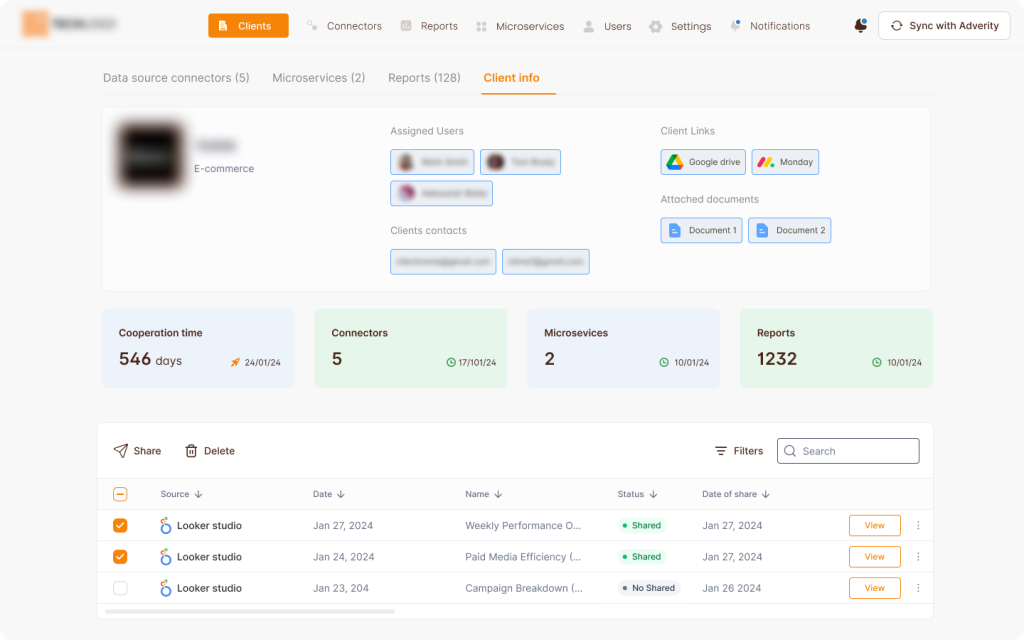
A scalable hub for portfolio-wide analytics helps clients structure marketing information for reporting optimization. It connects Adverity, BigQuery, and Looker Studio using reusable templates to standardize inputs across sources. This supports churn and propensity modeling across their portfolio and creates consistent dashboards. A client reduces manual preparation time and can track churn and risk across all accounts.
Our client runs a marketing intelligence practice across a large client portfolio. They consolidate performance data from multiple channels and treat analytics as a fundamental capability, built to scale consistently across engagements without relying on manual preparation.
Business challenge
Our client used Adverity to collect marketing information for multiple client accounts and wanted to keep it as their ingestion platform. While Adverity handled ingestion, the “last mile” work kept breaking. Enrichment rules, naming conventions, schema mapping, and normalization had to be manually configured and re-checked when a new client or paid media source was added.
This repetitive work introduced errors and schema drift. It slowed onboarding and undermined trust in metrics like churn rates in Looker dashboards.
The key challenge was to remove repetitive manual enrichment tasks and prevent schema drift across client streams. This had to be done within the existing tech ecosystem and a tight 10-week timeline, while supporting both per-client and portfolio-wide analytics.
Solution delivered
To fix these issues without replacing Adverity, our AI engineering team built a custom orchestration layer in Node.js/TypeScript. It treats Adverity configurations as deployable templates. When a new client account or source is added, the layer automatically applies a standard enrichment pack for consistent naming conventions and structures.
The enriched information flows into BigQuery as a standardized dataset for analytics and Looker Studio reporting.
This consistent schema supports analysis at both the per-client level and across the entire portfolio. It also delivers a reliable training dataset for BigQuery ML models on churn and propensity. This approach overcomes issues with inconsistent field names and formats.
Key features & components
Standardized data intake and preparation. Common data preparation rules were packaged into reusable sets. When new data sources are added, the system applies them automatically, keeping naming and structure consistent without manual effort.
A consistent data foundation. The team defined a shared data structure in BigQuery, mapping all sources to the same fields and formats. This removed ongoing inconsistencies and gave everyone a single, reliable view of the data.
Unified reporting environment. Looker Studio connects directly to BigQuery, providing a single place for reporting and analysis – both for individual clients and across the full portfolio.
Churn and propensity scoring in daily use. Churn and propensity models were built using BigQuery ML and integrated into regular reporting. Scores are generated on a schedule and treated like any other metric in dashboards, not as one-off analyses.
Repeatable client setup. A template-driven setup process allows new clients and data sources to be added in a consistent way, avoiding repeated manual configuration and rework.
Data quality built in. Standard preparation rules are applied by default, reducing errors and preventing inconsistencies before they reach reports. This minimizes the ongoing cleanup work that typically happens at the final reporting stage.
Technologies & tools
Adverity: data extraction and enrichment
Node.js/TypeScript: custom orchestration layer and template-driven configuration
The project focused on fixing structural issues in how marketing data was prepared and used day-to-day. The GetDevDone team delivered all the core improvements within a 10-week implementation window.
More predictable onboarding Adding new clients or data sources no longer meant rebuilding enrichment rules or fixing schemas by hand. Standard templates made onboarding more controlled, with fewer points of failure and less rework.
Reliable reporting data Using the same field names and formats across all sources removed the drift that had built up over time. Dashboards in Looker Studio now rely on a stable BigQuery structure, which reduced confusion around churn metrics and made the numbers easier to trust.
Practical portfolio-wide analysis Because every account followed the same data structure, the same analysis could be applied across all clients. The team could review churn and related metrics across the full portfolio without recreating datasets or reports.
Churn modeling in regular use With a consistent data foundation in place, churn and propensity models could run as part of regular operations. Outputs are treated like any other table and included in regular reporting, rather than managed as one-off exercises.
Faster data preparation Automating enrichment and data structure removed much of the ongoing cleanup work. Analysts spent less time correcting issues and more time reviewing results and helping teams act on them.
GetDevDone designed a luxury eCommerce store for an antique jewelry business with refined branding, intuitive navigation and product-centric architecture.
Talk to a commerce advisor to define the right architecture, platforms, and growth model for your business.
Get guidance on configuration, scalability, and compliance — tailored to your market and goals.