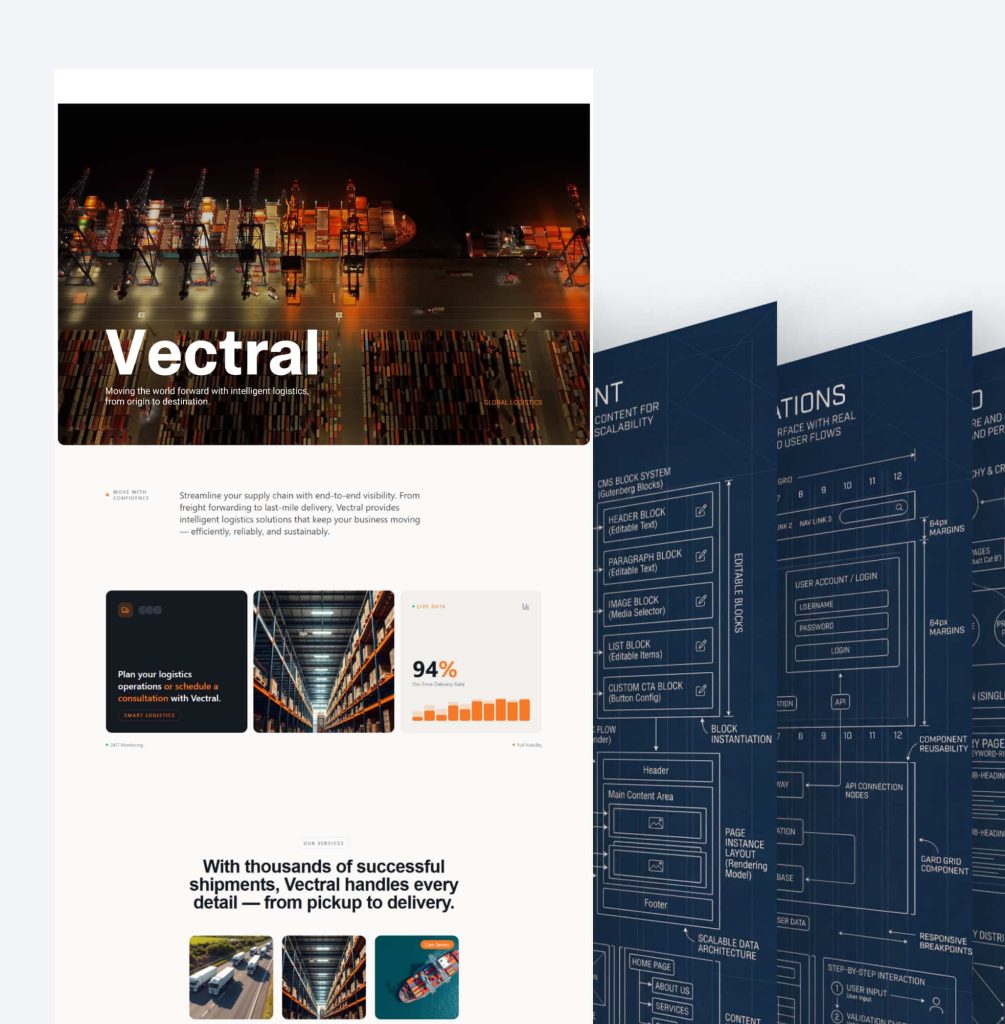
GetDevDone built a fully functional WordPress site using Gutenberg from a 12-page Lovable prototype already approved by the end client. The agency was able to hand it off to the marketing team for easy content edits, working form submissions, and search visibility, without the limitations of the original prototype.
Our client is a digital agency delivering websites, campaigns, and product experiences for businesses operating across multiple markets. The agency works across industries, coordinating teams and partners throughout the full delivery cycle, from scoping and design to implementation and launch with clear delivery outcomes.
Business challenge
The agency needed to deliver a production-ready WordPress site based on the client’s approved Lovable prototype, with the design signed off and the layouts finalized.
The challenge was the prototype itself. Lovable AI generated a React single-page application suitable for demos, but not for a production marketing site. Content was hardcoded into components with no CMS, forms lacked back-end functionality, and client-side rendering left search engines with little to index.
The look and structure had to remain exactly as approved, rebuilt in WordPress with a real CMS, functional forms, and a solid foundation for organic search.
AI prototypes not production-ready?
We turn agency experiments into client-ready sites
We rebuilt the site as a WordPress 6.x project using Gutenberg and a custom theme. The Lovable prototype served strictly as a visual and structural reference; its React and Tailwind code was not reused. Instead, layouts were implemented as editable Gutenberg blocks, allowing the marketing team to manage content directly.
Prototype audit. We started with a focused audit of the Lovable project URL and a GitHub export of the generated code. This included documenting page structure across all 12 pages, layout patterns, and responsive behavior, and the behavior of interactive elements.
Custom Gutenberg blocks. Recurring patterns (hero sections, feature grids, testimonials, and CTA strips) were rebuilt as reusable custom blocks. Each block is fully editable in the Gutenberg editor, enabling the marketing team to update content, swap assets, and reuse components without touching code.
Working forms. The original Lovable forms existed only at the UI level. We implemented fully functional submission flows in WordPress, including back-end processing, validation, spam protection, and email delivery for contact and inquiry forms.
SEO foundation. The AI engineering experts added the missing SEO layer, including semantic HTML, proper heading structure, meta titles, and descriptions via Yoast SEO, XML sitemap, Open Graph tags, and robots.txt.
Accessibility baseline. To meet WCAG baseline requirements, the team implemented alt text for all images, keyboard-navigable interactions, sufficient color contrast, and ARIA labels where appropriate.
Performance tuning. After optimizing images using responsive srcset and lazy loading, the production site achieved mobile LCP under 2 seconds, down from roughly 4.2 seconds in the prototype.
Finally, the site was deployed to a staging environment on WP Engine for review, then pushed to production. The client received admin access, a walkthrough of the Gutenberg editor, and documentation for all custom blocks. Then the content was migrated manually from the prototype into WordPress.
Technologies & tools
WordPress 6.x with Gutenberg block editor
Custom WordPress theme with block templates
ACF Pro: structured content in custom blocks
WP Forms: form handling
Yoast SEO: metadata and sitemap management
Business outcomes
Production-ready WordPress delivery in 3 weeks The agency received a fully functional WordPress site just 3 weeks after handing over the approved Lovable prototype. Instead of wrestling with Lovable’s React output: patching forms, bolting on SEO, and accepting that content edits would require ongoing dev support, they received a clean rebuild that behaves like a standard, maintainable website.
Marketing productivity & SEO control The end client’s marketing team can now update content, create new pages using existing blocks, and manage SEO directly in the block editor without relying on a developer for routine changes.
Improved performance On the technical side, the site passes Core Web Vitals on both mobile and desktop. Mobile LCP improved from around 4.2 seconds in the prototype to under 2 seconds in production, resulting in faster load times and a stronger foundation for organic traffic.
GetDevDone built an AI-powered knowledge assistant that turns the agency's internal document library into a searchable source of truth for the account team.
AI-generated code broke a Stripe and Memberstack integration in the payment system. See how GetDevDone diagnosed, reconciled, and fully restored the system.
Talk to a commerce advisor to define the right architecture, platforms, and growth model for your business.
Get guidance on configuration, scalability, and compliance — tailored to your market and goals.