White-label Shopify development companies help with different agency needs, so the best choice depends on your project complexity, delivery model, and technical requirements.
Choose GetDevDone for scalable website development, white-label Shopify delivery, including store builds, theme development, QA, maintenance, and overflow production support.
Consider VT Labs, Elogic Commerce, or Codup for Shopify Plus, enterprise commerce, custom integrations, B2B projects, or technically complex implementations.
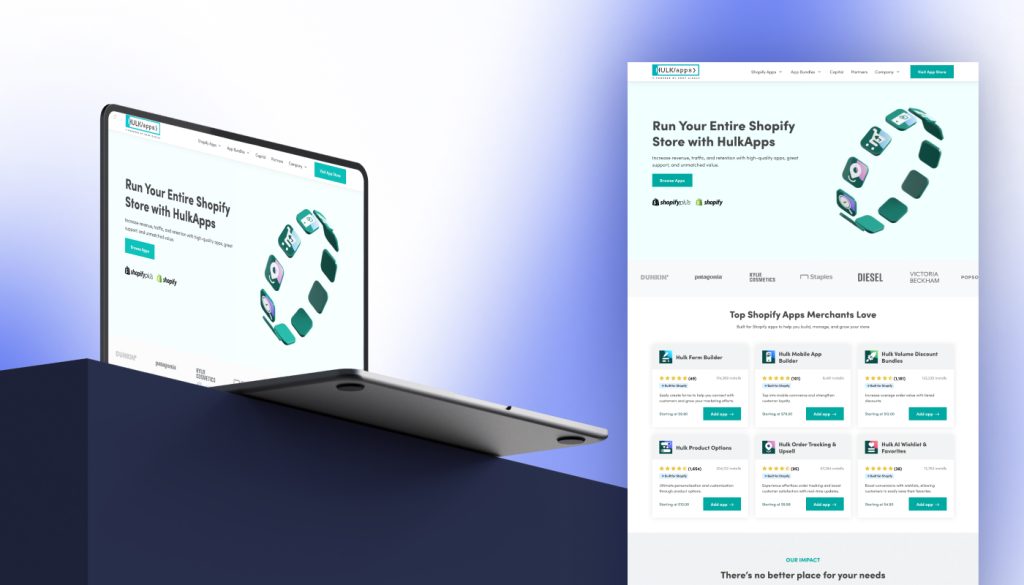
Select HulkApps when Shopify apps, app integrations, and ongoing store enhancements are central to the project.
Look at WebDesk Solution for standard Shopify implementation and long-term support.
Opt for Swanky and Charle for growth-focused Shopify Plus engagements combining development with CRO, international expansion, or eCommerce optimization.
Shopify development company choice depends on the agency delivery fit. Some work directly with merchants, while others are built to support agencies through white-label Shopify implementation. This guide compares white-label Shopify development companies that agencies can rely on for client store builds, redesigns, migrations, theme development, and ongoing production support.
What are the best white-label Shopify development companies?
The best white-label Shopify development companies support agencies with behind-the-scenes Shopify delivery, including theme development, store builds, integrations, QA, launch support, and maintenance.
We’ve analyzed Shopify developers, and our top picks are GetDevDone, VT Labs, Elogic Commerce, HulkApps, Codup, WebDesk Solution, Swanky, and Charle. GetDevDone is the strongest fit for production-focused white-label delivery, while other vendors may be a better fit for Shopify Plus, enterprise commerce, app-heavy builds, or regional collaboration.
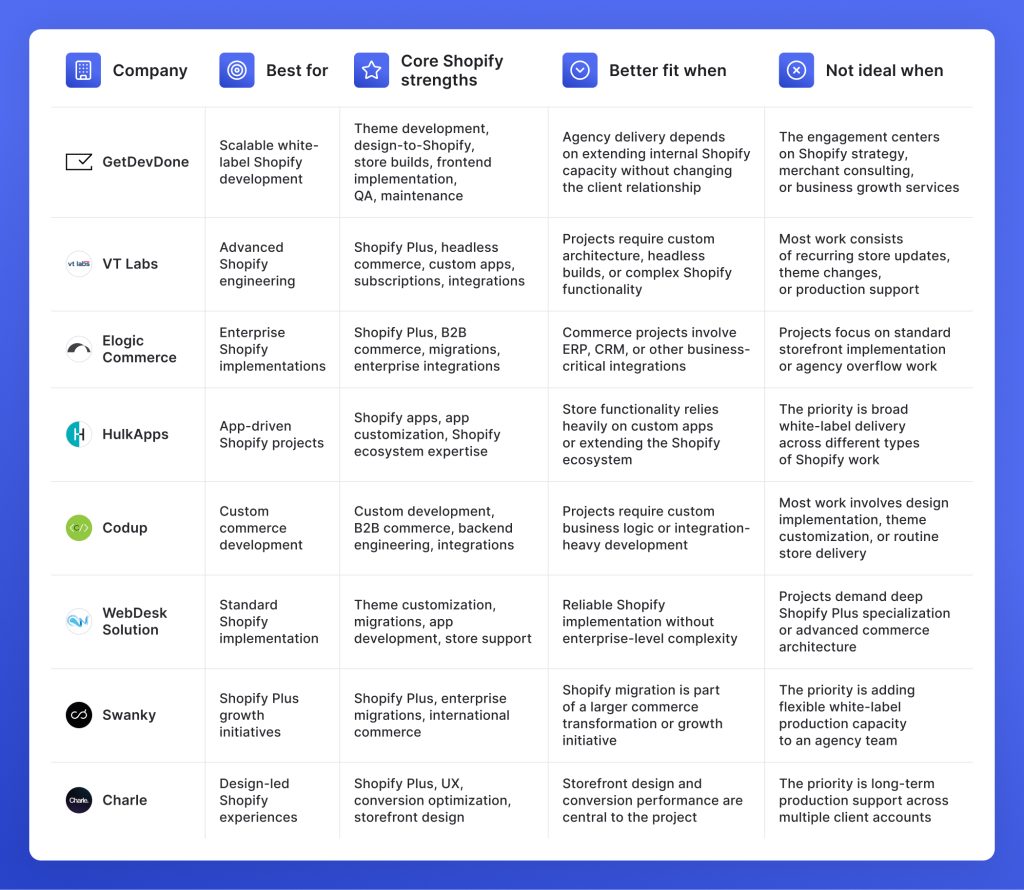
How the best Shopify development companies for agencies compare
Similar service pages don’t always mean similar delivery models. The comparison below looks at where each Shopify development partner fits within common agency workflows and project types.
Evaluation criteria for white-label Shopify development companies
Companies were evaluated using publicly available evidence of Shopify service visibility, white-label or agency-fit signals, project experience, Shopify-specific capabilities, production readiness, QA and launch support, maintenance support, and relevance to agency delivery.
The evaluation also considered service pages, portfolios, case studies, third-party reviews, and documented delivery processes. GetDevDone was included and assessed using the same criteria as every other company in the comparison.
4 checkpoints for choosing a white-label Shopify development partner
How to choose a Shopify developer when technical capability isn’t the only consideration? The day-to-day delivery model has as much impact on the partnership as the Shopify work itself. Based on our experience delivering Shopify projects for agencies, we’ve identified four checkpoints worth validating before choosing a development partner.
Confirm the partner is built for white-label delivery
Working behind the scenes under NDA is only one part of white-label delivery. The stronger partners can also follow agency-owned communication, project management, design review, QA, and approval processes without creating extra work for the client-facing team.
Match technical strengths to the work you sell
Shopify companies offer similar services on paper but specialize in different types of delivery. Theme development, Shopify Plus, migrations, app-heavy builds, performance optimization, and long-term maintenance require different experience. Choosing a partner based on real project mix usually leads to a better fit than comparing service pages alone.
Look beyond launch
Launch isn’t the end of an agency engagement. Bug fixes, merchant requests, Shopify updates, and ongoing improvements often continue for months. A delivery partner should be able to support post-launch work without disrupting agency workflows.
Choose a commercial model that matches your pipeline
Some partners work best on fixed-scope implementations, while others are structured for ongoing retainers or overflow delivery. The right engagement model often has as much impact on delivery quality as technical capability.
The best white-label Shopify development partners for different agency needs
The companies below solve different agency delivery challenges by offering white-label website development services. Compare them based on the Shopify projects you deliver, the level of production support you need, and the delivery model that best fits your agency.
GetDevDone
Best for: Agencies that need white-label Shopify development services for client store builds, theme development, design-to-Shopify implementation, maintenance, and production support.
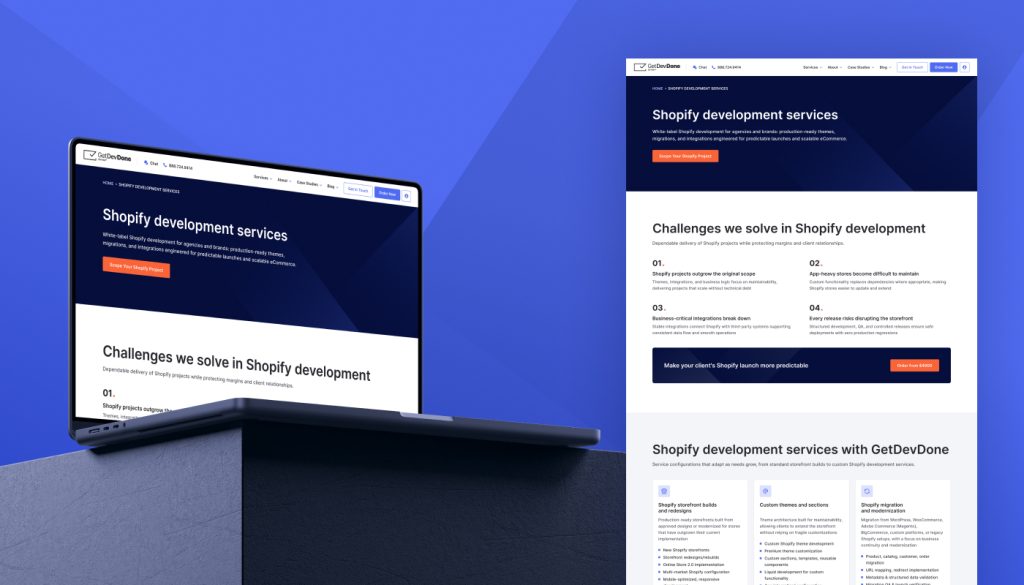
Why it is included: GetDevDone’s delivery model is built around agency partnerships. Agencies can use the team as an extension of their own delivery capacity for Shopify implementation, theme customization, store rebuilds, migrations, integrations, QA, launch support, and ongoing maintenance while keeping client communication, project ownership, and strategy in-house.
Although the prototype had already been approved, it lacked the commerce infrastructure required to process payments, manage products, track inventory, and fulfill orders. The GetDevDone team rebuilt the prototype as a custom Shopify theme, migrated the product catalog, configured payments, shipping, and tax settings, and delivered a production-ready storefront with QA and launch support.
Strengths:
Delivery model built for agency partnerships
White-label Shopify implementation from approved designs
Theme customization, store rebuilds, and frontend development
QA, launch support, and post-launch maintenance
Flexible production capacity for overflow delivery
Broader engineering support for integrations and custom functionality
Limitations: Less suitable for agencies looking for a partner focused primarily on Shopify Plus strategy, merchant-facing commerce consulting, paid media, brand strategy, or marketplace growth services instead of white-label Shopify development execution.
Turn your AI prototype into clean, production-ready code.
Best for: Agencies delivering Shopify Plus projects, headless commerce implementations, custom app development, and integration-heavy Shopify solutions.
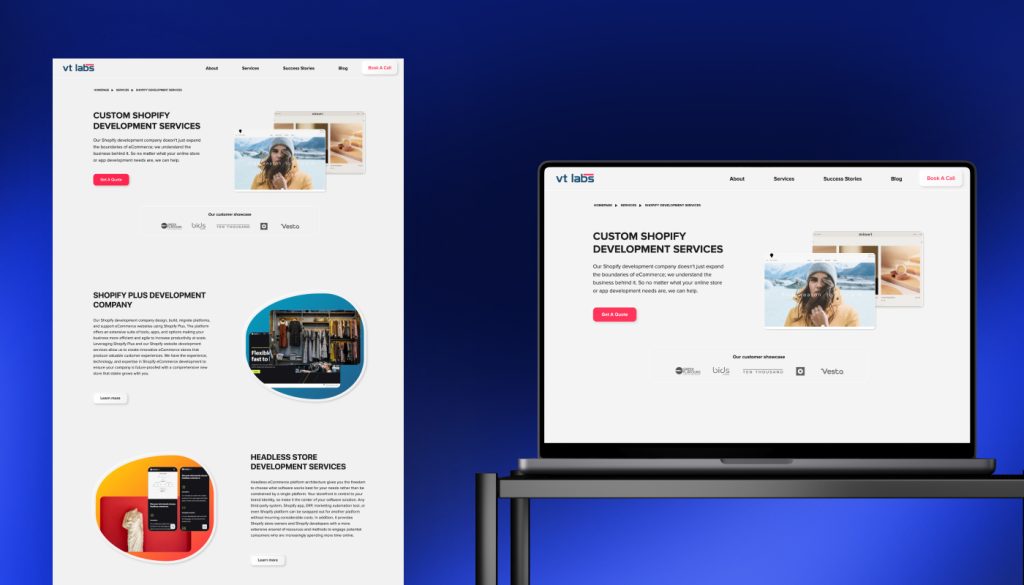
Why it is included: VT Labs focuses on technically complex Shopify implementations, with a strong emphasis on Shopify Plus, headless commerce, custom applications, and scalable eCommerce architecture. Its service offering extends beyond standard store development to include subscription commerce, checkout extensibility, migrations, ERP integrations, and ongoing eCommerce optimization.
Relevant services:
Shopify Plus development
Headless Shopify development
Shopify app development
Shopify migrations
Custom Shopify development
Shopify integrations
Ongoing Shopify support
Evidence: VT Labs publicly positions Shopify as its primary development focus and maintains dedicated service pages for Shopify Plus, headless commerce, custom app development, checkout extensibility, and migrations. Its portfolio includes Shopify and Shopify Plus success stories across beauty, pet care, jewelry, travel, and fashion, covering subscription commerce, custom themes, Shopify Flow automation, and theme migrations.
Strengths:
Strong Shopify Plus and headless commerce expertise
Custom Shopify applications and integrations
Subscription commerce and checkout customization
Experience with technically complex eCommerce implementations
Flexible engagement models, including dedicated teams and time-and-material projects
Broad Shopify engineering capabilities beyond theme development
Limitations: Projects centered on recurring theme implementation, design-to-Shopify delivery, and overflow development may align better with a production-focused white-label partner.
Elogic Commerce
Best for: Agencies supporting Shopify Plus, B2B commerce, enterprise migrations, ERP integrations, and large-scale digital commerce initiatives.
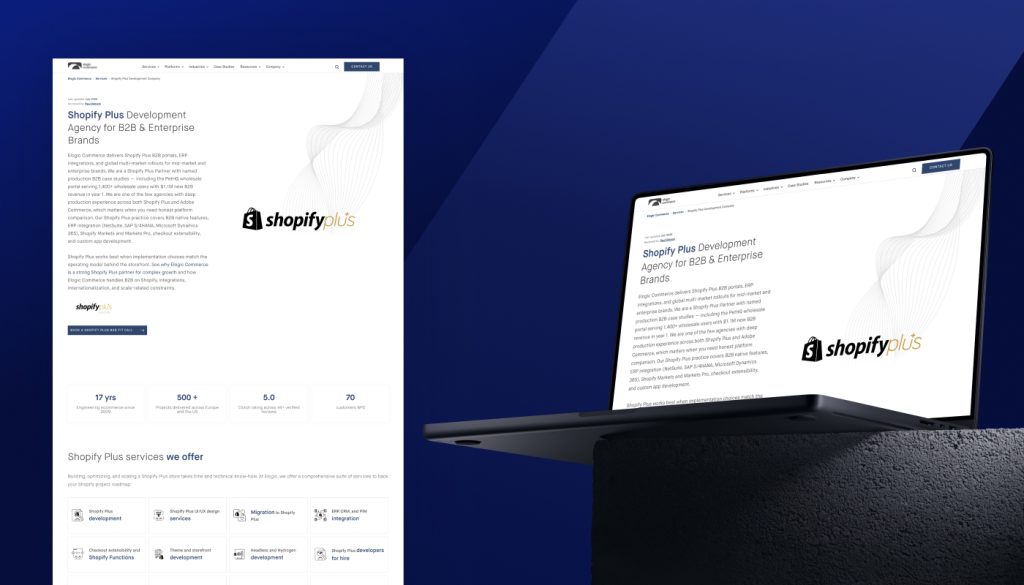
Why it is included: Elogic Commerce combines Shopify Plus implementation with enterprise commerce consulting, making it well suited for complex B2B and multi-market projects. Its expertise includes platform selection, discovery, ERP, CRM, PIM, and OMS integrations, international rollouts, and long-term commerce optimization.
Relevant services:
Shopify Plus development
Shopify Plus migrations
ERP, CRM, and PIM integrations
B2B portal development
Shopify Markets implementation
Checkout extensibility
Headless Shopify development
Shopify Plus consulting and support
Evidence: Elogic Commerce is a Shopify Plus Partner with dedicated Shopify Plus and B2B service offerings. The company supports businesses across retail, manufacturing, fashion, consumer goods, electronics, and pet care, including integrations with ERP platforms such as SAP, Microsoft Dynamics 365, and NetSuite. Its portfolio includes enterprise Shopify Plus implementations with reported outcomes such as $3.7 million in new D2C revenue and $1.1 million in first-year B2B revenue from newly launched commerce channels.
Strengths:
Enterprise Shopify Plus and B2B expertise
ERP, CRM, PIM, and OMS integration capabilities
Discovery, platform consulting, and commerce strategy
Multi-market and international Shopify implementations
Proven experience with large-scale migration and replatforming projects
Strong portfolio of enterprise commerce case studies
Limitations: Projects centered on recurring white-label implementation, design-to-Shopify execution, and overflow production support may align better with a delivery partner focused primarily on agency operations.
HulkApps
Best for: Agencies building Shopify stores that rely on custom apps, app integrations, ongoing store enhancements, and long-term technical support.
Why it is included: Unlike agencies centered primarily on custom storefront development, HulkApps has built much of its Shopify expertise around the Shopify app ecosystem. In addition to providing outsourced Shopify development, the company designs, maintains, and supports a broad portfolio of Shopify apps.
Relevant services:
Shopify development
Shopify app development
Shopify app customization
Shopify app integrations
Shopify Online Store 2.0 development
Shopify CRO and A/B testing
Shopify ADA compliance
Ongoing Shopify support
Evidence: HulkApps publicly offers Shopify development support alongside a portfolio of 20+ proprietary Shopify apps, many of which serve hundreds of thousands of merchants through the Shopify App Store. The company also provides structured monthly support packages with dedicated development resources, QA, project management, and post-launch support for ongoing Shopify improvements.
Strengths:
Extensive Shopify app ecosystem expertise
Custom app development and app integrations
Long-term Shopify support and enhancement services
Experience with Online Store 2.0 customization
CRO, A/B testing, and conversion-focused improvements
Mature support model for continuous Shopify development
Limitations: Projects focused primarily on custom Shopify Plus architecture, enterprise commerce consulting, or large-scale replatforming may align better with partners specializing in complex enterprise implementations.
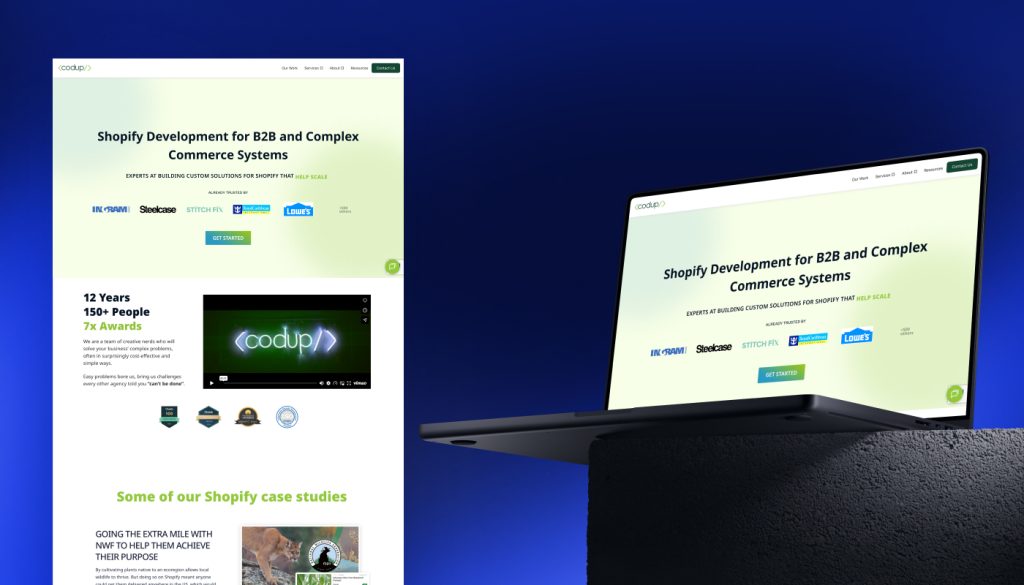
Codup
Best for: Agencies delivering custom Shopify development, B2B commerce, system integrations, and complex eCommerce projects.
Why it is included: Codup is a custom development partner for businesses whose Shopify requirements extend beyond standard themes and off-the-shelf functionality. Its offering combines Shopify development with custom applications, ERP and CRM integrations, replatforming, headless commerce, and B2B solutions.
Relevant services:
Custom Shopify development
Shopify Plus development
Shopify app development
System integrations
B2B eCommerce development
Headless commerce
Platform migration and replatforming
Performance optimization
Evidence: Codup publishes Shopify case studies covering B2B commerce, custom Shopify applications, CRM integrations, subscription commerce, custom themes, and operational automation. Its portfolio includes projects for National Wildlife Federation, One Tree Planted, Multiply Eyewear, Quadro, and CoinsTV, addressing ERP and CRM connectivity, custom subscription models, fulfillment automation, and business-specific Shopify functionality.
Strengths:
Strong custom Shopify engineering capabilities
B2B commerce and system integration expertise
Custom Shopify apps and business workflow automation
Experience with complex merchant requirements
Migration and replatforming support
Solution-oriented engineering approach
Limitations: Projects focused primarily on recurring theme updates, production-only implementation, or ongoing overflow delivery may align better with partners specializing in high-volume white-label execution.
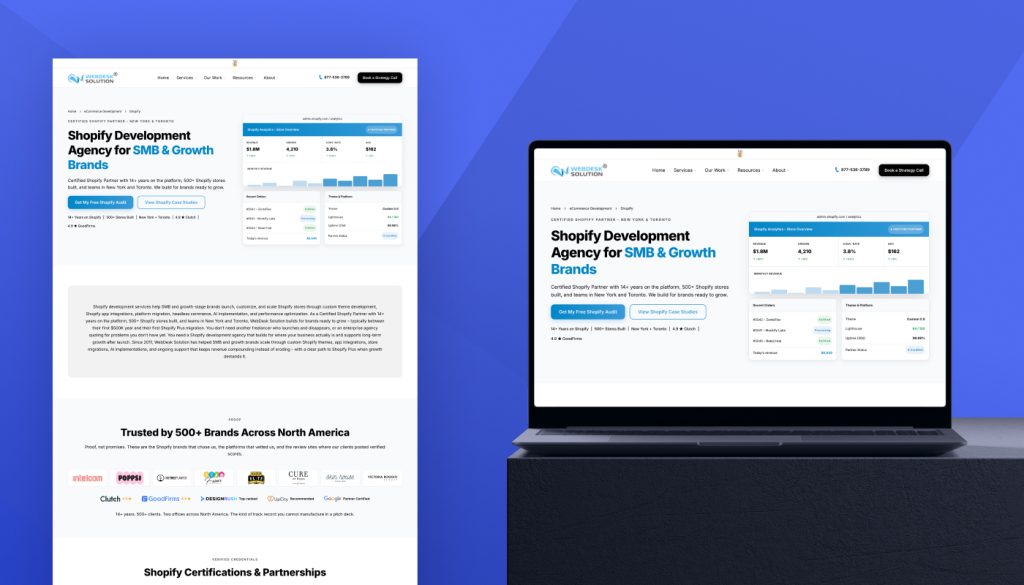
WebDesk Solution
Best for: Agencies supporting SMB and mid-market Shopify merchants that need one partner for store development, migrations, integrations, ongoing optimization, and long-term technical support.
Why it is included: WebDesk Solution is a full-service Shopify development agency focused on businesses growing into more advanced Shopify implementations rather than enterprise commerce transformation. Its offering combines store builds, Shopify 2.0 upgrades, migrations, ERP integrations, AI implementation, CRO, maintenance, and digital growth services under one team.
Relevant services:
Shopify development
Shopify theme customization
Shopify migrations
Shopify app development
Shopify API integrations
Shopify ERP & CRM integrations
Shopify 2.0 upgrades
Shopify maintenance and support
Evidence: WebDesk Solution reports 14+ years of Shopify experience, 500+ Shopify stores delivered, and dedicated Shopify teams in New York and Toronto. The company publishes detailed Shopify case studies covering Shopify Plus B2B storefronts, Shopify 2.0 upgrades, migration projects, custom wholesale workflows, booking integrations, and ERP connectivity across retail, beauty, automotive, jewelry, and home services. It also maintains 4.9-star ratings on Clutch and GoodFirms alongside multiple Shopify developer certifications.
Strengths:
Broad Shopify delivery covering build, migration, optimization, and support
Strong experience with Shopify 2.0 modernization projects
Shopify Plus wholesale and B2B implementations
ERP, CRM, AI, and marketplace integrations
Ongoing maintenance, monitoring, and technical support
Suitable for agencies serving SMB and growth-stage merchants
Limitations: Projects centered on advanced Shopify Plus architecture, headless commerce engineering, or highly specialized Shopify application development may align better with partners dedicated to those technical areas.
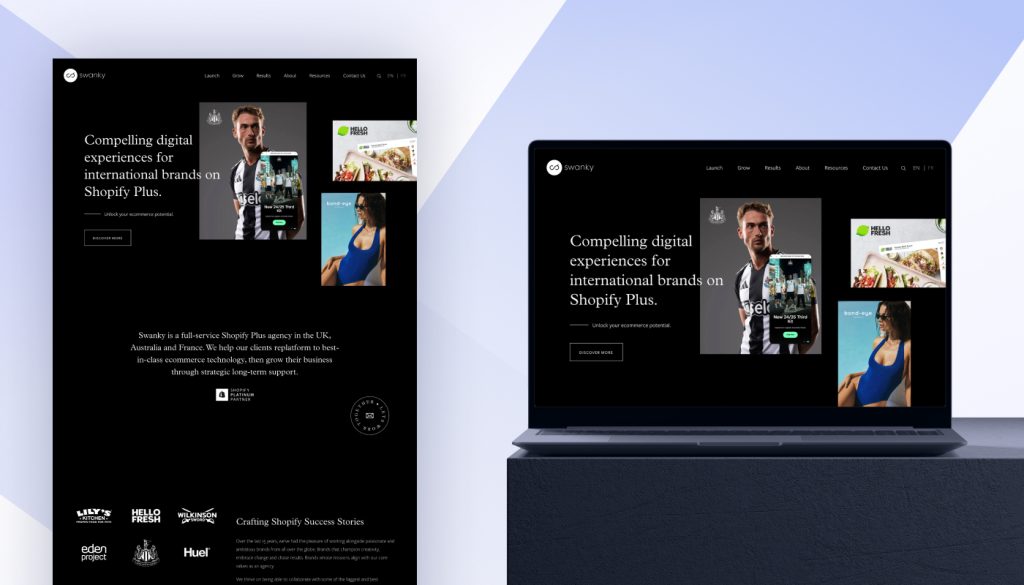
Swanky
Best for: Agencies supporting established Shopify Plus brands that need enterprise replatforming, international expansion, and long-term eCommerce growth services alongside Shopify development.
Why it is included: Swanky combines Shopify Plus implementation with commercial eCommerce consulting. It helps brands migrate to Shopify, optimize customer experience, expand into new markets, and improve long-term store performance. Alongside Shopify development, the company offers CRO, digital marketing, subscription commerce, international expansion, branding, and ongoing optimization for established eCommerce brands.
Relevant services:
Shopify Plus development
Shopify migrations and replatforming
Shopify theme development
Shopify Markets implementation
Shopify integrations
Subscription commerce
Conversion rate optimization (CRO)
Digital marketing and long-term growth support
Evidence: Swanky is a Shopify Platinum Partner, publicly specializing in Shopify Plus delivery for international brands. Its portfolio includes Shopify migrations, Shopify Markets implementations, subscription commerce, custom theme development, and enterprise storefront redesigns across furniture, fashion, beauty, home, and retail brands. Published case studies report an 84% year-over-year increase in sales following a Shopify theme upgrade and a doubling of eCommerce revenue after a four-week WooCommerce migration.
Strengths:
Shopify Plus replatforming for established brands
International eCommerce and Shopify Markets expertise
Subscription commerce and omnichannel retail
CRO and long-term eCommerce growth programs
Enterprise migrations with accompanying UX improvements
Broad commercial expertise beyond implementation
Limitations: Production-focused agency overflow, design-to-Shopify implementation, and recurring white-label development capacity are not the primary focus of the company’s service model.
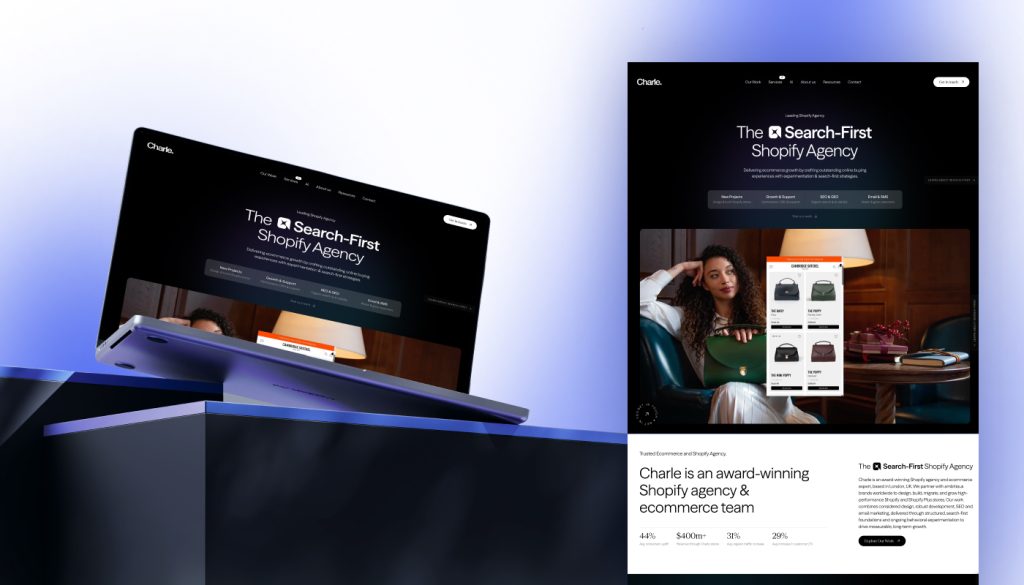
Charle
Best for: Agencies supporting Shopify and Shopify Plus brands that prioritize conversion optimization, SEO, and retention.
Why it is included: Charle brings together Shopify design and development with CRO, SEO, GEO, retention marketing, and ongoing optimization under one offering. It is a strong choice for agencies supporting ambitious Shopify brands that need continuous eCommerce growth after launch.
Relevant services:
Shopify Plus development
Shopify migrations
Custom Shopify theme development
Shopify app integrations
Conversion rate optimization (CRO)
Shopify SEO & GEO
Email & SMS marketing
Shopify support and retainers
Evidence: Charle positions Shopify and Shopify Plus as its core platform and showcases an extensive client portfolio that includes Cambridge Satchel, 111SKIN, Samsung, Beauty Bay, and Muc-Off. As a result of its services, the company reports an average 44% increase in conversion rates and a 29% increase in customer lifetime value.
Strengths:
Strong Shopify Plus and eСommerce growth expertise
Search-first approach combining SEO, GEO, and CRO
Long-term optimization through dedicated support retainers
Conversion-focused Shopify design and development
Extensive portfolio of established eСommerce brands
Integrated retention marketing with email and SMS
Limitations: Less suitable for agencies looking primarily for a production-focused engineering partner delivering large-scale custom applications, ERP integrations, or backend-heavy Shopify implementations.
Which Shopify development company is right for your agency?
Best for white-label Shopify development for agencies
Choose GetDevDone when your agency needs a long-term white-label delivery partner that can take ownership of Shopify implementation, QA, launch, and ongoing client work without changing the agency-client relationship.
Consider WebDesk Solution if most projects involve standard Shopify implementation, migrations, and recurring support for SMB or mid-market merchants.
Opt for Codup when white-label delivery also requires custom business logic, B2B workflows, or integrations with external business systems.
Best for Shopify Plus and larger eСommerce projects
Swanky is the strongest fit when Shopify migration is part of a broader eСommerce growth strategy involving international expansion, CRO, and long-term optimization.
Elogic Commerce is a good option if Shopify must integrate with ERP, CRM, PIM, or other enterprise systems while supporting B2B or multi-market operations.
VT Labs is well suited to Shopify Plus projects built around headless commerce, custom applications, subscription models, or advanced technical architecture.
Charle fits brands where Shopify development is expected to improve conversion, organic growth, and customer retention alongside implementation.
Best for custom Shopify theme development
GetDevDone is a strong choice when approved Figma or PSD designs need to become production-ready Shopify themes with clean implementation, QA, and launch support.
WebDesk Solution works well for Shopify 2.0 theme customization, storefront modernization, and ongoing updates after launch.
Swanky is a better fit when custom theme development is one part of a broader Shopify Plus redesign or brand transformation initiative.
Best for Shopify app and integration-heavy projects
HulkApps is the strongest choice when store functionality depends on Shopify apps, app customization, or extending the Shopify ecosystem.
Codup is proven when Shopify needs to connect with ERP, CRM, or other operational systems through custom integrations and business-specific workflows.
VT Labs is a better fit for projects requiring subscription platforms, Shopify Flow automation, checkout extensibility, or headless architecture.
Elogic Commerce is well suited to enterprise commerce environments where Shopify operates alongside multiple business platforms.
Best for Shopify migration or rebuild projects
GetDevDone is a reliable option for rebuilding Shopify stores from approved designs while handling QA, launch readiness, and post-launch support.
Swanky specializes in Shopify Plus replatforming tied to international growth, digital transformation, and long-term eСommerce strategy.
Elogic Commerce supports migrations that include enterprise integrations, B2B workflows, or complex operational requirements.
Best for ongoing Shopify maintenance and overflow support
HulkApps works well for merchants requiring continuous app updates, store enhancements, and long-term technical improvements.
WebDesk Solution is a practical choice for recurring Shopify maintenance, feature enhancements, and operational support across growing Shopify stores.
GetDevDone is the strongest fit for agencies that need predictable white-label capacity to handle recurring client requests, maintenance, and overflow delivery.
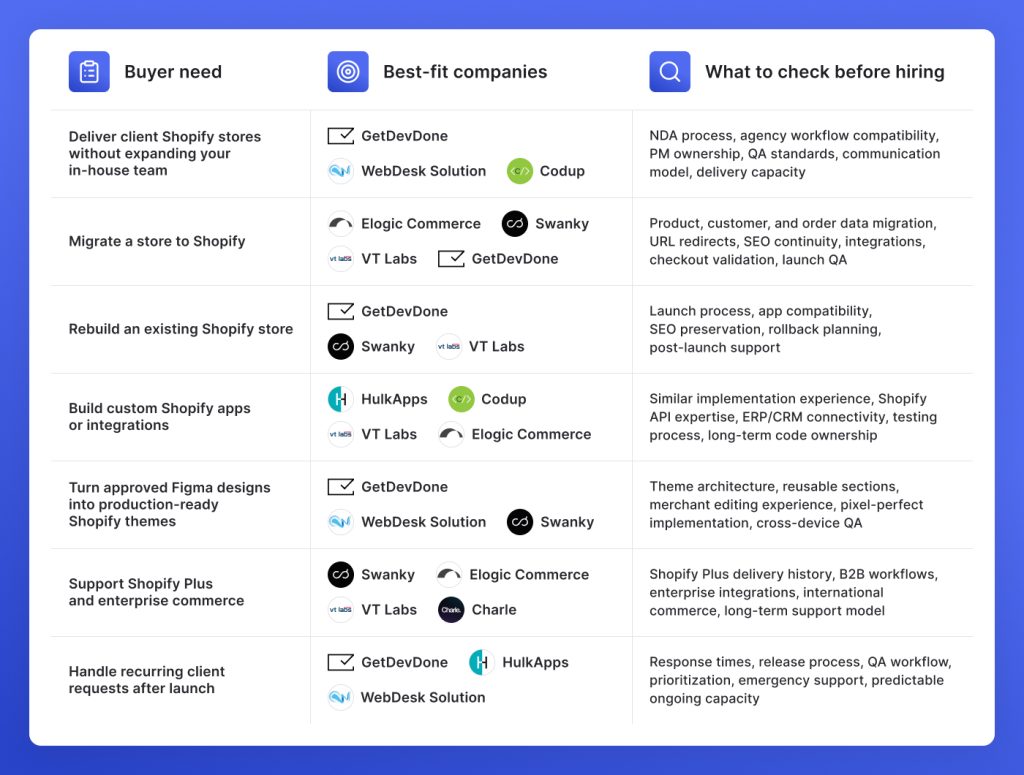
Shopify development partner decision matrix
Several companies in this comparison offer similar Shopify services, but they solve different agency challenges. Use the decision matrix below to match your project with the vendors most likely to deliver it successfully.
FAQs about white-label Shopify development companies for agencies
Use white-label Shopify development services when client demand exceeds your internal Shopify capacity or requires expertise your team doesn’t have. This model works best when the agency continues to own strategy, design, client communication, and project management, while the development partner handles implementation, QA, launch support, and ongoing technical delivery behind the scenes.
A Shopify agency works directly with merchants, while a white-label Shopify development partner supports another agency’s client delivery. Agencies usually provide strategy, UX, branding, and growth services, whereas white-label partners integrate into the agency’s workflow to deliver Shopify development under the agency’s brand, processes, and communication model.
Choose a Shopify development partner based on delivery capability, not service lists alone. Review Shopify-specific project experience, theme and integration expertise, QA processes, launch support, NDA readiness, communication workflows, and evidence that the team can fit into your agency’s delivery process without creating additional management overhead.
Yes, if your agency already owns strategy, UX, design, content, and client communication. A white-label Shopify development partner can build the store, configure functionality, perform QA, and support launch. If the client also expects branding, CRO, paid media, or long-term eСommerce strategy, additional specialists are typically required.
Agencies can safely outsource production-focused Shopify work when the scope and requirements are clearly defined. This commonly includes theme development, Figma-to-Shopify implementation, store setup, template customization, landing pages, app configuration, third-party integrations, QA, maintenance, migration support, and other scoped development tasks that follow an approved specification.
Many delivery issues stem from poorly defined project requirements. Unclear scope, incomplete design handoffs, overlooked app dependencies, performance problems, SEO migration mistakes, insufficient QA, and undefined post-launch ownership are among the most common reasons Shopify projects miss deadlines or require rework.
Choose a Shopify Plus partner for enterprise commerce projects and a general Shopify development company for standard Shopify delivery. Shopify Plus specialists are a better fit for B2B commerce, international storefronts, complex integrations, and advanced checkout requirements. General Shopify development partners may be better suited to custom themes, white-label delivery, recurring client requests, and agency overflow work.
The cost of white-label Shopify development services depends on project scope rather than a fixed hourly or package rate. Key Shopify development cost factors include design complexity, the number of templates, custom functionality, integrations, migration requirements, QA effort, launch support, and the chosen engagement model. Agencies should compare estimates based on deliverables, assumptions, and ongoing support.
Editorial disclaimer
This is not an independent research report, analyst ranking, sponsored placement, or paid directory listing. The companies included in this article were identified and evaluated using publicly available information available at the time of publication, including company websites, service pages, case studies, portfolios, and verifiable third-party review platforms, combined with AI-assisted research and human editorial review conducted by the GetDevDone team. The selection and ordering of companies reflect our editorial judgment regarding their visible relevance to agencies and white-label Shopify delivery capabilities based on the criteria discussed in this article. Different agencies, project requirements, budgets, and operating models may reasonably lead to different conclusions. We have made a good-faith effort to evaluate companies based on verifiable public information rather than marketing claims alone. However, this list is not exhaustive, definitive, or free from editorial perspective.
Hiring a Shopify developer makes sense when store requirements, complexity, and strategy outgrow what standard themes, apps, and DIY implementation can support.
Bolt.new AI-generated prototype turned into a functional Shopify storefront with a custom Liquid theme, payments, inventory, and commerce infrastructure
Best headless eCommerce platforms compared: commerce tools, Shopify Plus, and BigCommerce on API-first architecture, composable CMS, pricing, and rollout steps
Talk to a commerce advisor to define the right architecture, platforms, and growth model for your business.
Get guidance on configuration, scalability, and compliance — tailored to your market and goals.