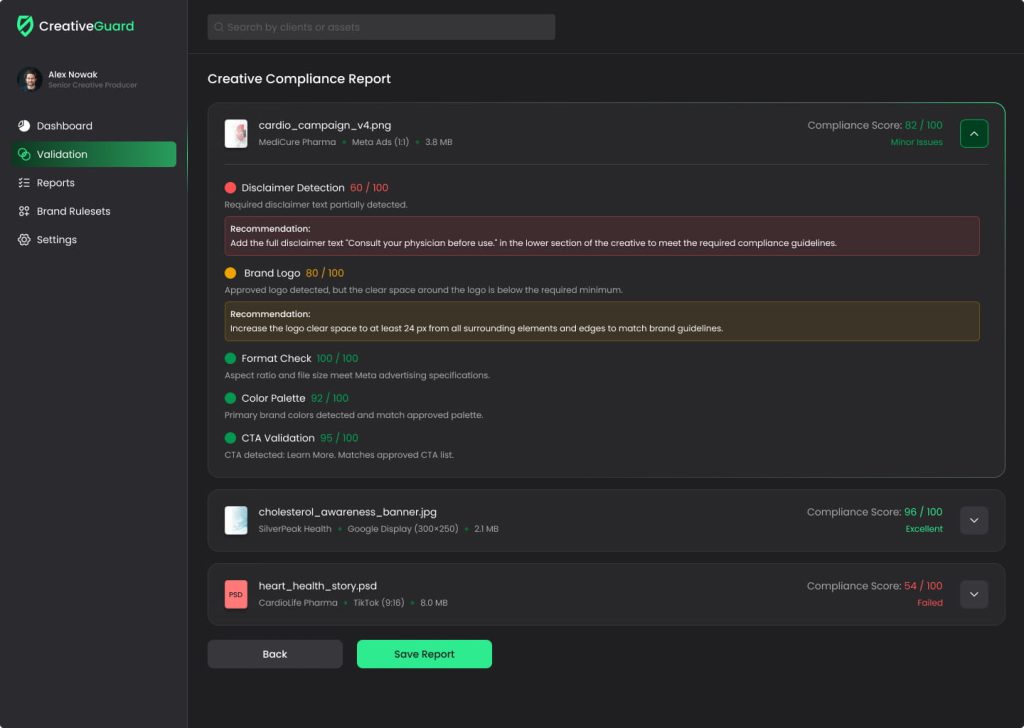
An AI-powered validation system by GetDevDone replaces manual pre-launch ad reviews for a media agency. The system checks creatives against brand rules, disclaimers, and platform specs, then flags issues with fix instructions before anything goes live.
A media agency producing paid creatives for clients across health and pharma. The production team delivers hundreds of static assets per month for Meta, Google Display, TikTok, and LinkedIn placements.
Business challenge
As the agency’s client portfolio grew, pre-launch checks done manually by a designer and manager stopped scaling. Incorrect logos, missing disclaimers, and format mismatches were often caught only after delivery, or once campaigns were already live, creating rework and exposing the agency to client, financial, and reputational risk.
Our client needed a control layer that could check finished static creatives against client-specific rules before release, without slowing production or changing the existing workflow. The solution also had to keep editorial control with the production team: AI could validate, but not generate, rewrite, or auto-correct the creative.
Solution delivered
GetDevDone’s AI engineering team built an intelligent asset validation system with embedded AI features that check static paid creatives against client-specific rules before they go live. The solution replaces inconsistent, availability-dependent manual review with a structured pre-launch validation gate.
How the validation workflow works
Creatives are uploaded through a review interface and processed automatically through a validation pipeline. The system first verifies file metadata against platform requirements for Meta, Google Display, TikTok, and LinkedIn, including dimensions, aspect ratio, file type, and file size.
Once format compliance is confirmed, the AI validation layer runs. A visual layer reviews creative elements against approved brand rules and reads on-image text, while a copy-validation layer verifies required disclaimers and confirms that the CTA matches the approved client options.
Each asset exits the workflow with a Red / Yellow / Green result. Every issue is tied to the relevant rule and paired with a plain-language fix instruction, giving designers a clear path to correction without a separate interpretation step.
Key features
Client-specific rulesets. Each client has a set of dedicated rules defining approved brand usage and restricted content, including explicit “do not use” conditions.
Automated asset processing. Creatives are uploaded through a React-based review interface, triggering the validation pipeline via Cloud Functions for Firebase.
Format compliance checks. File metadata (dimensions, aspect ratio, file size, file type) is verified against platform specifications before AI-based validation begins.
AI-assisted validation. A lightweight LLM supports rule-based checks such as disclaimer presence and approved CTAs, without generating or modifying creative content. In parallel, a visual validation layer checks brand elements and reads on-image text against defined rules.
Structured pass/fail reporting. Each asset receives a Red / Yellow / Green result, with every flag linked to a violated rule and a clear fix instruction.
Audit log. All validation results are stored in Firestore with timestamp, asset reference, and outcome for traceability.
Technologies & tools
Node.js / TypeScript: backend and validation pipeline
OpenAI GPT-4o-mini: copy and disclaimer validation
OpenAI vision capabilities: visual detection and on-image text reading
Cloud Storage for Firebase: asset upload and trigger-based processing
Cloud Firestore: rulesets, results, and audit log storage
React: review and validation UI
AI-generated prototypes not ready for production?
We turn AI-generated prototypes into production-ready solutions.
At the end of the project, the system turned a fragile manual review step into a repeatable pre-launch control for static ad production. Delivered in 6 weeks within the planned budget, it gave the agency a clearer and more consistent way to validate creatives before they reached clients or went live.
Operational efficiency Designers can run validation independently using the report output, reducing reliance on senior colleagues for routine compliance checks.
Lower pre-launch risk Issues are caught before assets leave production, rather than during client review or after campaign launch. That reduces rework and helps protect client relationships.
More consistent review quality Validation no longer depends on reviewer availability, workload, or time pressure. Review standards stay stable as asset volume grows.
Faster correction cycles Each flagged issue includes the rule reference and a plain-language fix instruction, making rework more direct and cutting back-and-forth between design and review.
Auditable validation history Stored results provide a reviewable record for internal accountability and client-facing transparency.
GetDevDone built an AI-powered knowledge assistant that turns the agency's internal document library into a searchable source of truth for the account team.
Best headless eCommerce platforms compared: commerce tools, Shopify Plus, and BigCommerce on API-first architecture, composable CMS, pricing, and rollout steps
AI-generated code broke a Stripe and Memberstack integration in the payment system. See how GetDevDone diagnosed, reconciled, and fully restored the system.
Agencies rarely lose profit in one crisis, they bleed it away hour by hour. We call this the delivery tax, the hidden cost of unclear discovery, scope creep, and weak governance. This piece shows where it comes from, why mid-size teams feel it most, and the simple structures that stop the margin leak.
GetDevDone designed a luxury eCommerce store for an antique jewelry business with refined branding, intuitive navigation and product-centric architecture.
Talk to a commerce advisor to define the right architecture, platforms, and growth model for your business.
Get guidance on configuration, scalability, and compliance — tailored to your market and goals.